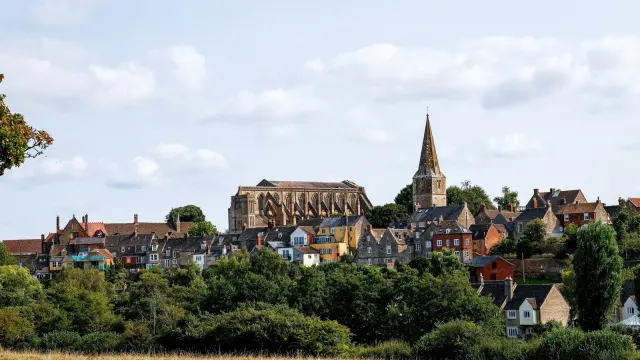
A market town about two hours from Edinburgh, Dumfries packs an unlikely amount of history into its winding lanes. Robert Burns spent his final years here, Robert the Bruce killed his rival for the Scottish throne in its old church in 1306, and J.M. Barrie, the man behind Peter Pan, spent time here too. All this, plus a river running right through the middle of town.
Start at the cobblestone square by the red sandstone Greyfriars Church, where a statue of Burns stands. From there it's a short walk down the High Street to Robert Burns House on Burns Street — a rust-coloured stone cottage where the poet lived out his last years in the 1790s. Inside, the rooms are furnished as they would have been in his day, and his actual desk and chair survive. Unusually for a historic house, visitors say you can touch some of the exhibits.
If medieval drama is more your thing, a plaque opposite the church marks where Robert the Bruce killed John Comyn, his rival for the crown, inside the Old Greyfriars Church in the winter of 1306. The original church is long gone, but the act set Bruce on his path to the Scottish throne. For a broader sweep of local history, the round-towered Dumfries Museum — built as a Victorian observatory — holds everything from early Christian carvings to fossilised footprints of prehistoric animals.
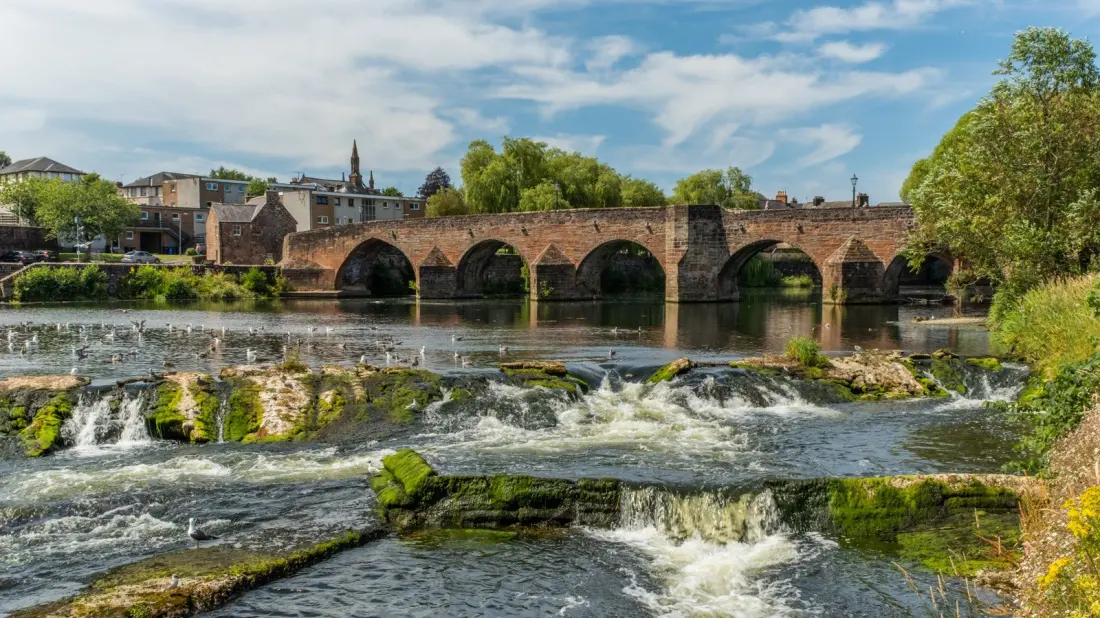
The River Nith gives the town its nickname and its best views. The Whitesands promenade, a short walk from the square, looks towards Devorgilla's Bridge, a medieval crossing whose swooping arches are the town's postcard shot. Follow the riverside path from there to Dock Park, which has a playground, lawns and a paved, tree-shaded trail along the water — good picnic territory. About 15 minutes further on, Castledykes Park sits on the site of the destroyed Dumfries Castle, now marked by a monument, with a Sunken Garden full of wildflowers that's especially pretty in autumn.
For a town this quiet, Dumfries is well connected: roughly two hours from Edinburgh by car or a train-plus-bus combo, and under an hour's drive from the English border. Accommodation spans everything from The Cairndale Hotel & Spa to small bed-and-breakfast cottages.
Dumfries works for slow-paced travellers who like their sightseeing walkable and their history literary. It also makes a handy base for bigger trips: the South West Coastal 300, one of Scotland's underrated driving routes, starts from the area, and the charming river town of Kirkcudbright — pastel houses, good seafood, a creative streak — is about 90 minutes away by car. If your mental map of Scotland stops at Edinburgh and the Highlands, this corner of the southwest is worth adding.