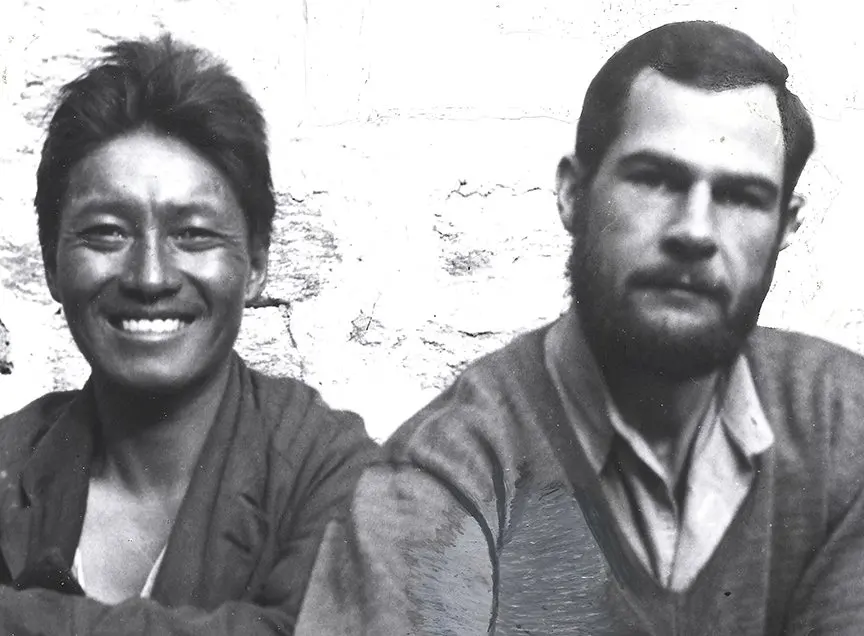
The summit photo of Tenzing Norgay from May 29, 1953 is one of mountaineering's most famous images. Less known: the wool helmet under his hood was a parting gift from Earl Denman, a broke Canadian engineer who in 1947 talked Tenzing into an illegal, absurdly under-equipped attempt on Everest from Tibet.
Denman was born on Vancouver Island in 1914 but raised mostly in England, dreaming of the Rockies. Work took him to Sudan, then the Virunga volcanoes of Central Africa, which he claimed to be the only person to have climbed all eight of. He decided Everest should be climbed the same minimal way — a few men, no expedition army — and set off from Bulawayo in February 1947 with about £250, a second-hand camera with punctured bellows, and no permit for Tibet.
In Darjeeling, interpreter Karma Paul, veteran of the prewar British expeditions, initially called the plan impossible and sheer suicide, but eventually introduced Denman to two Sherpas: Ang Dawa and Tenzing Norgay, already a "Tiger" who'd been to 27,000 feet on Everest. Denman's pitch to Tenzing was simple: on an official expedition you'd be a porter; with me, if we succeed, we succeed together. Tenzing later admitted he knew better — but "the pull of Everest was stronger for me than any force on earth."
The trio slipped over the Tibetan frontier on a little-used pass, dodging patrols, nearly losing their supplies when yaks tumbled down a slope, and reaching Rongbuk Monastery on Everest's north side. Moving fast — covering in four days what the 1933 British expedition needed weeks for — they hauled everything themselves in tents that "gave as much protection as a sheet of paper." Blasted by savage wind, they pushed up the slopes below the North Col before turning back around 23,500 feet with hands near frostbite. The whole round trip from Darjeeling took five weeks. Tenzing later credited Denman's decision to retreat as something he was grateful for the rest of his life.
Denman returned in 1948 with better gear but still no permit, and Tenzing refused a second illegal crossing. Denman left his equipment, including that balaclava, with Tenzing. They kept in touch by letter — Tenzing dictated his — and as late as January 1953, Tenzing wrote that if Denman ever got permission, he'd rather climb with him than any other party. Instead, Tenzing joined John Hunt's British expedition and made history with Edmund Hillary. Denman's own 1954 memoir, Alone to Everest, is long out of print, and his name is absent from the cast list of Jennifer Peedom's new film Tenzing.
Why care? The story threads through places travellers can still visit: the tea-town streets of Darjeeling, Rongbuk Monastery beneath Everest's north face, and the Virunga volcanoes straddling Congo, Rwanda and Uganda. It's also just a great reminder that Everest history has more characters than the famous ones.