Skytrax ranks Emirates' premium economy as the best in the world, which is notable given that the product only launched in May 2022. The Dubai-based carrier was the first major Middle Eastern airline to add the cabin, debuting it on an Airbus A380 with 56 seats at the front of the main deck, initially flying to high-demand routes like London, Paris and Sydney.
The roll-out has been swift. Boeing 777-300ERs followed with a smaller 24-seat cabin, all incoming Airbus A350-900s arrive with premium economy fitted (21 or 28 seats), and ten 777-200LRs have been retrofitted. Ahead, Emirates plans the cabin on 110 A380s and 71 777-300ERs, plus 73 more A350s and — remarkably — every one of its 270 ordered Boeing 777Xs.
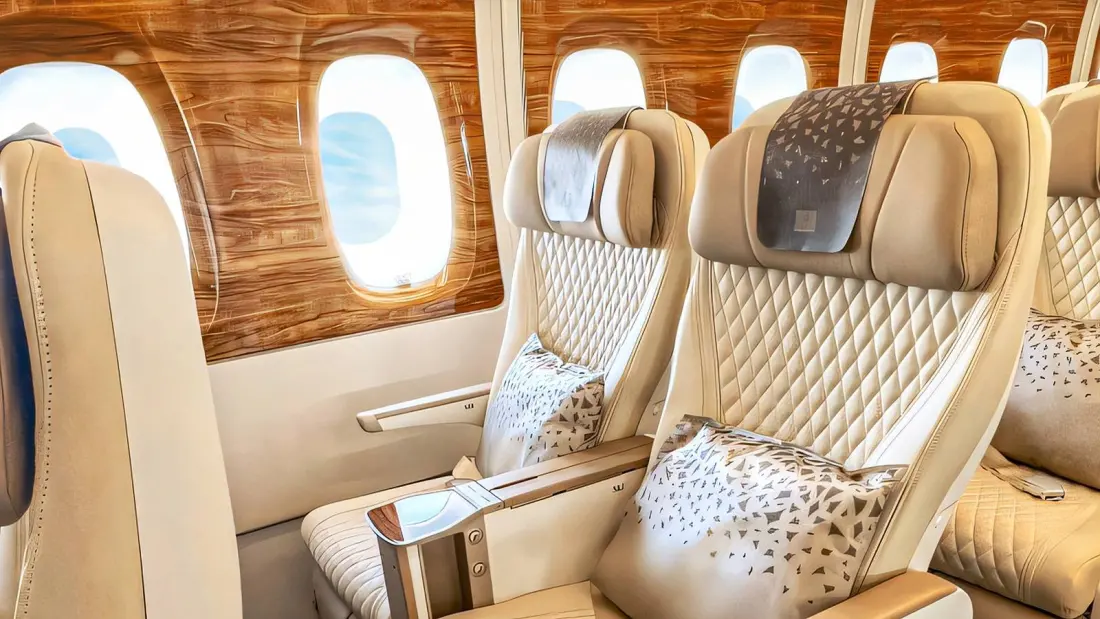
What's interesting is that the hardware isn't exotic. The seat is a fairly standard Recaro PL3530, without privacy dividers, wireless chargers or flashy 4K screens. Emirates wins on dimensions instead: 40 inches of pitch versus the usual 38, eight inches of recline, a calfrest and footrest, and 19.5 inches of width — maintained on the A350 by fitting seven seats per row where eight is the norm.
The soft product does heavy lifting too. Expect an amenity kit with Aveda lip balm, hand cream and face lotion, plus the usual socks, eye mask and dental kit, alongside catering that's a clear cut above most premium economy offerings and attentive crew service in a small cabin.
The catch is price. Premium economy fares industry-wide sit closer to business class than economy, partly because airlines keep cabins small and demand has never been higher — a supply-and-demand imbalance that lets carriers hold pricing power. Emirates has trimmed fares on some routes, but the product is still known as pricey. Whether it's worth it depends on your budget: you're paying for noticeably more space and comfort, not a flat-bed suite. For long-haul flights where business class is out of reach, though, few premium economy cabins are better judged than this one.