If your idea of a winter city break involves more than browsing Christmas stalls, a string of European cities is turning squares, parks and even a Roman amphitheatre into open-air skating rinks this season. Many sit against serious architectural backdrops - a castle, a national museum, a city hall - and most come with mulled wine within arm's reach.
The most spectacular setting may be Pula, Croatia, where an ice rink opens on 5 December inside the city's 2,000-year-old Roman Arena, its ancient arches lit up for Advent. Budapest's City Park Ice Rink (Városligeti Műjégpálya) trades Roman ruins for Vajdahunyad Castle and a serious pedigree - it has been operating since 1870, making it one of Europe's oldest outdoor rinks. It opens on 20 November 2026.
Zurich offers sheer scale at the Dolder rink in the wooded Dolderwald area: 6,000 square metres of ice, open now until 7 March 2027, and a calmer alternative to the festive rinks crammed into city squares. Vienna goes in the opposite direction with density: Wiener Eistraum wraps illuminated skating trails around Rathausplatz and the surrounding park, running 22 January to 7 March 2027, with a smaller Christmas-market version from 13 November.
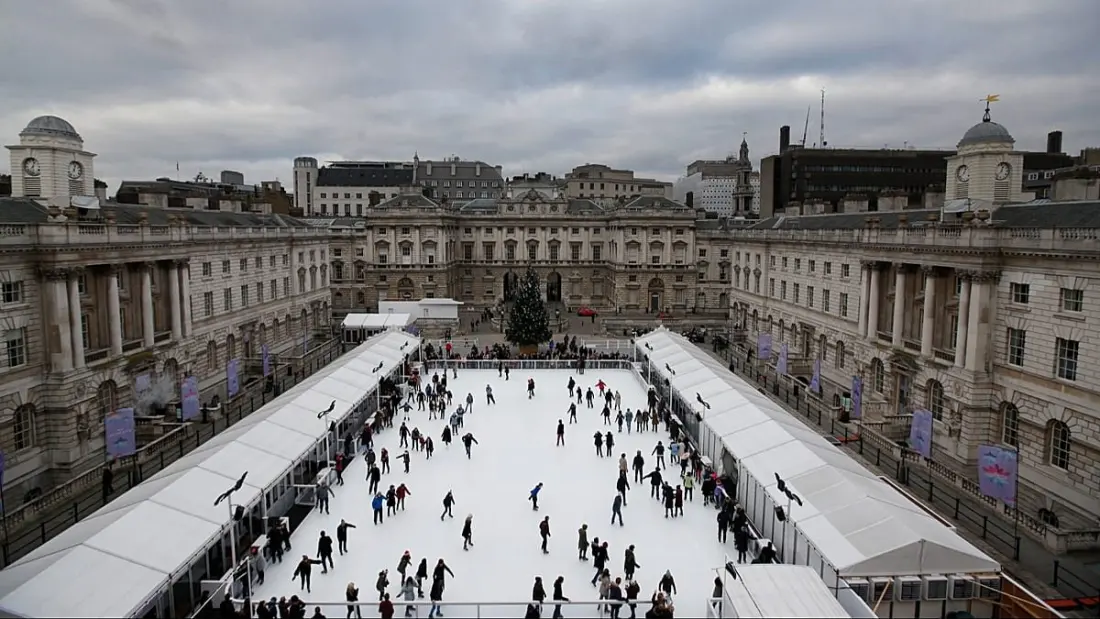
For museum-district skating, Amsterdam's Museumplein rink puts the Rijksmuseum right behind the ice until 16 January 2027, while London's Somerset House brings DJs and a grand courtyard from 11 November 2026 to 10 January 2027 (closed Christmas Day).
Germany has three solid options: Munich's Münchner Eiszauber at Karlsplatz with Bavarian food huts and themed sessions (13 November to 10 January), Cologne's Heinzels Winter Fairytale rink at Heumarkt (23 November to 10 January, closed 24-25 December), and Berlin's rink by the Neptune Fountain at the Rotes Rathaus, complete with a Ferris wheel, open 23 November to 3 January.
Scandinavia keeps it central and easy. Stockholm's Kungsträdgården rink reopens mid-November as an accessible intro to Swedish skating culture. Oslo's Spikersuppa opens 28 November near Karl Johans gate and the National Theatre. Copenhagen's Kongens Nytorv sets 1,300 square metres of ice around the equestrian statue of Christian V, with gløgg and hot chocolate from nearby stalls from November.
Dates matter more than usual here. Most rinks cluster their seasons between late November and early January, so a trip in mid-December catches the most markets and rinks at once. But a handful - Vienna, Zurich and the Dolder, for instance - run into late February or early March, which suits anyone who prefers skating without peak-season crowds and prices.
Who is this for? Anyone stitching a short-haul winter trip together and wanting one active thing to anchor each day. Most of these rinks are free to enter or charge modest skate-hire fees, sit within walking distance of main sights, and pair naturally with a market visit in the evening. Check each rink's dates before booking flights, though - Christmas closures are common, and some seasonal rinks only open once the markets do.
Originally reported by Euronews Travel.