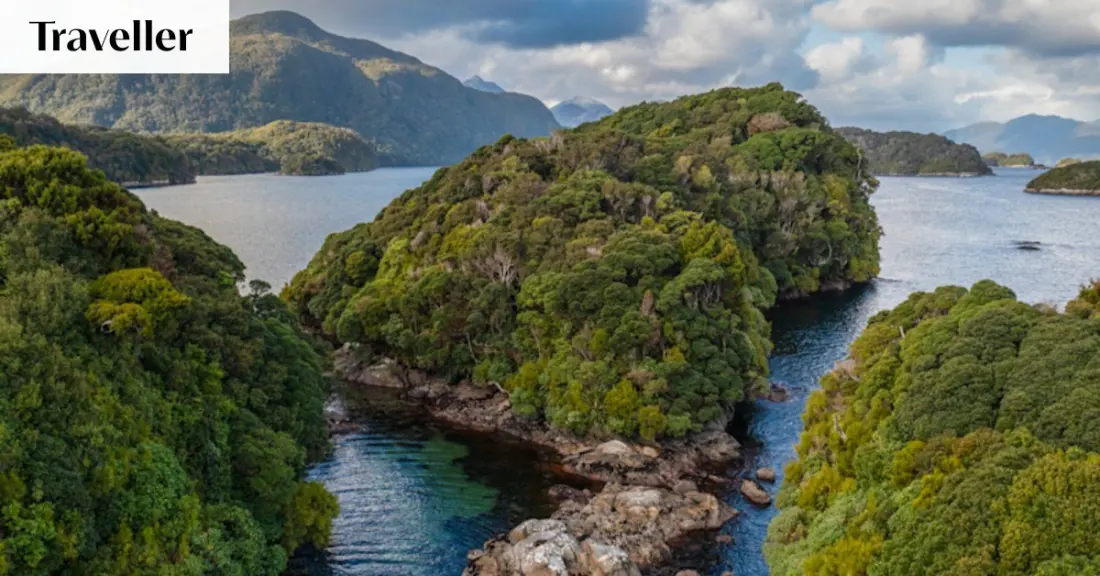
Nearly two million people cruise Norway's fjords each year. New Zealand has a southern-hemisphere equivalent — 14 fjords spread across 12,000 square kilometres of World Heritage-listed national park in the country's south-west — and it draws a fraction of that. Milford Sound, the only fjord with a road, sees around 800,000 visitors annually. The rest of Fiordland? Fewer than 1,000 people a year arrive by expedition boat, despite it being under three hours' flight from Australia.
A six-night sailing with Fiordland Discovery gets you into the heart of it. The route runs from Preservation Inlet on the south-western tip of the South Island, north through Chalky Inlet, Dusky Sound and Breaksea Sound, ending in Doubtful Sound. Getting there takes less than six hours door to deck: fly to Queenstown, drive two hours to Te Anau, then a 45-minute helicopter ride through snow-capped peaks down to the boat — the Fiordland Jewel, a 24-metre catamaran with its own helipad and just 18 passengers.
The payoff is genuine emptiness. Our writer saw a single other vessel — a lobster boat — in six days. No roads, no towns, no power lines. It was here that Captain Cook spent five weeks in 1773 repairing his ship in Dusky Sound, and his naturalist's description of the "deepest silence" still holds. Where you actually go is weather-dependent; the skipper plans only the start and finish, and no two trips are the same.
Wildlife is a constant: bottlenose dolphins riding the bow (they grow to four metres and weigh as much as a horse), Fiordland crested penguins, fur seals, and migrating humpback whales in the open crossings between fjords. The forests hide rare birds too — including kakapo, the world's heaviest parrot, on the brink of extinction. On one two-hour forest hike the writer heard two kakapo calling in the canopy, enough to move a seasoned New Zealand hiker to tears.
There's European history here as well: Dusky Sound hosted New Zealand's first sealers and whalers, and Preservation Inlet has a short-lived gold-rush town called Cromarty, now just mine and building skeletons. Days fill with hikes under 1,000-year-old beech trees, kayaking past curious seal pups, hauling lobster pots with the crew, and eating the haul — southern rock lobster up to nine kilograms, plus blue cod and hapuku — at communal dinners. Rain is constant, which is a feature: it turns the forested mountain slopes into endless waterfalls, best watched from the top-deck hot tub.
This is for travellers who want remoteness without a long-haul flight, and who like their wilderness served with a hot tub and fresh crayfish. Pack sea legs — the fjords are separated by open Tasman water — and a tolerance for the fact that the itinerary is entirely up to the weather.