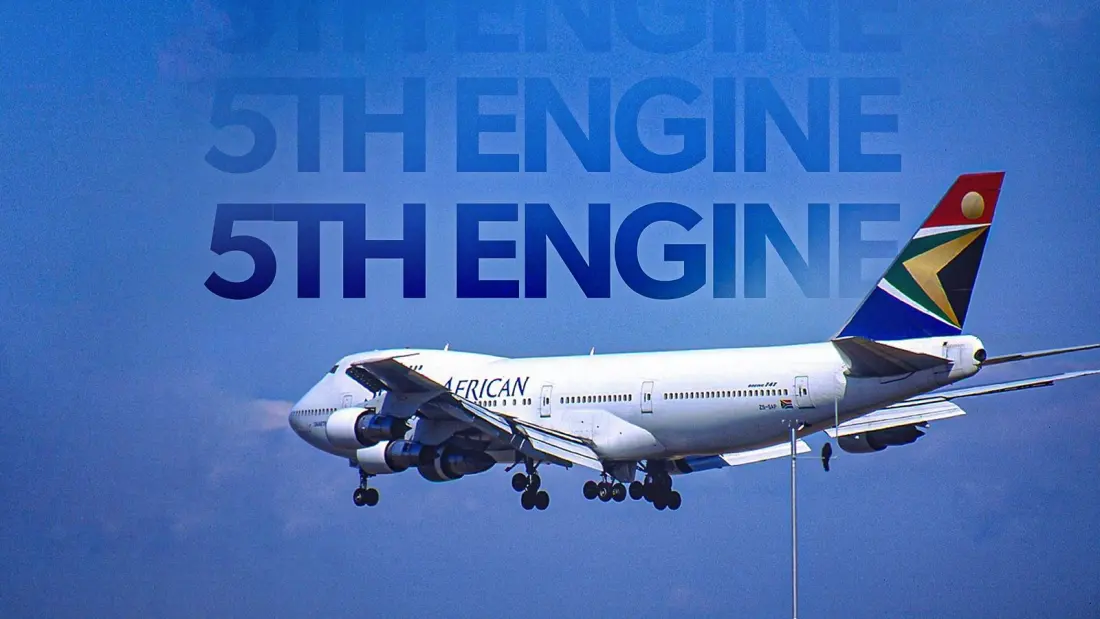
For decades, a Boeing 747 could legally take off with a spare jet engine bolted under one wing — not powering anything, just cargo. This was the fifth-pod ferry flight, one of the quirkiest solutions in commercial aviation, and Qantas was its undisputed champion.
The problem it solved was simple but brutal. Early high-bypass turbofans like the Pratt & Whitney JT9D and Rolls-Royce RB211, groundbreaking when the 747 entered service in 1970, were far less reliable than today's engines. If one failed at a remote outstation, the aircraft was stuck. Cargo planes of the era often couldn't fit a fully assembled multi-ton turbofan, so airlines faced weeks of Aircraft on Ground delays waiting for sea freight.
Boeing's answer was to build a dedicated hardpoint into the 747's port wing, between the fuselage and the number two engine, placing the dead weight close to the centreline to limit stress. The spare engine was completely inert — no fuel, electrics or hydraulics — with fan blades removed or locked and the whole thing wrapped in fairings to stop it windmilling in the airflow.
Flying with it was no picnic. The extra drag of roughly 6,000 kg hanging under the left wing created a persistent leftward yaw that demanded constant rudder input, cruise speed was capped around Mach 0.78, and fuel burn jumped 10-15%. Long rescue runs needed planned refuelling stops, like Perth before the Indian Ocean crossing to Johannesburg. The practice went back to 1959, when Qantas fitted its Boeing 707s with external mounts; British Airways, Singapore Airlines, South African Airways, Aer Lingus and TWA all ran certified programmes later.
The most recent case study came on 6 January 2016, when Qantas 747-438 VH-OJS ferried an RB211 under its wing from Sydney to Johannesburg — via Perth — to rescue a sister aircraft stranded without heavy maintenance support. One passenger jet effectively delivered a replacement engine to another, cutting weeks off the logistics.
The capability has since disappeared, and not by accident. Modern turbofans exceed 99.9% dispatch reliability, purpose-built freighters like the 747-8F and An-124 can carry whole engines internally, and today's twinjets — the A350, the 777X — were never designed with external hardpoints at all. The trick lived and died with the four-engine jumbo era.
Why should a traveller care? It's a window into how much of smooth long-haul flying is hidden logistics. That engine failure that barely dents your itinerary today was once a two-week ordeal solved by improvising a six-tonne package onto a passenger jet. If you ever flew a 747 before the mid-2010s, you may well have shared a cabin with a spare engine three metres from your window seat — and never known.