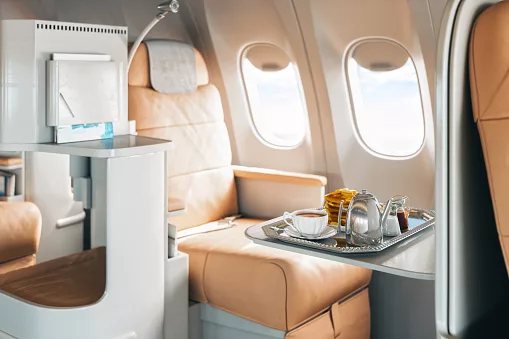
Economy seats are quietly becoming the minority on some long-haul flights. Airlines worldwide are racing to add lie-flat beds, private suites, couch-style seating and chef-designed meals because passengers who pay for comfort are simply worth more — sometimes worth far more.
The maths explains the rush. Purdue University aviation economist Volodymyr Bilotka told AFP that a business-class seat takes up roughly the floor space of four economy seats but pulls in five to six times the revenue. American Airlines is a case in point: premium products brought in about half of its ticket revenue last quarter while making up only around 30% of its seats, with premium revenue up 18.5% year-on-year. With jet fuel costs squeezing margins, higher-yield cabins are the industry's most obvious lever.
The buildout is happening fast. In the US, premium seats on domestic flights have grown 33% since 2020, according to Skift. United Airlines plans to more than double its premium-seat capacity between 2015 and 2026, and its new ideas target the squeezed middle: a "Relax Row" arriving in 2027 will let economy passengers on selected wide-body Boeing jets convert three seats into a couch for sleeping, while a new Economy Plus option launching in late 2026 will guarantee you don't share a row with a middle-seat stranger. JetBlue, long a budget carrier, has launched BlueFirst on domestic routes.
The comfort race goes beyond the seat. Delta is upgrading its Delta One cabins with restaurant-quality menus developed with Michelin-starred chef Simon Hulstone of The Elephant in Torquay, plus curated wines chosen by sommelier Andrea Robinson, larger entertainment screens and a rollout on new Airbus A350-1000s. Delta's onboard strategy chief Ekrem Dimbiloglu suggested premium seating could eventually reach 70% of capacity on some flights. Lounges, free Wi-Fi and pre-ordering meals are now part of the pitch too.
It's not just a US story. British Airways is converting the entire upper deck of its A380s to premium seating. Singapore Airlines has committed €1.4 billion to new long-haul cabins, including a first-class double bed measuring 203cm by 152cm. Business-class-only carriers like BeOnd and La Compagnie skip economy altogether, and UK operator Jet2 is adding a chartered Boeing 737-800NG configured with 76 business-class seats.
Consultancy Cirium puts the overall shift in numbers: premium seats now make up 19% of combined capacity across 42 airlines in the three big global alliances plus Middle Eastern carriers, up from 17.1% in 2019.
What does this mean if you fly economy? Expect a more tiered cabin. Standard economy seats will be scarcer on some routes, and airlines will keep looking for small ways to upsell you — extra legroom, better seat locations, paid perks. The upside is that mid-tier options like premium economy and hybrid products such as Relax Row give travellers a ladder of comfort between a cramped middle seat and a four-figure lie-flat bed. The bottom line: comfort is becoming something you explicitly buy, not something you're given.