Two hours-ish from Seattle, on the forested edge of Port Townsend Bay, sits a state park with an unusual backstory. Fort Townsend Historical State Park is a 367-acre patch of Douglas fir, hemlock and cedar that used to be a working military post — one of the first on the Salish Sea — before fire, abandonment and time let the forest take it back.
The land was long home to S'Klallam, Quileute and Suquamish peoples before the U.S. government acquired it via the 1855 Treaty of Point No Point, and the fort itself dates to 1856. Its military life ended abruptly in 1895 when fire destroyed the barracks. Aside from a WWII stint as a munitions disposal site, the area stayed quiet until Washington turned it into a state park in 1953.
Today it works as a compact day-trip or overnight base. Roughly 40 campsites for tents and RVs (plus two primitive walk-in spots and a group site for up to 60 people) open April through October and should be reserved through the Washington State Parks website. Day visitors need a Discover Pass — $10 a day or $45 annually, which covers all of Washington's 140-plus state parks — though the state announces free-entry days during the year.
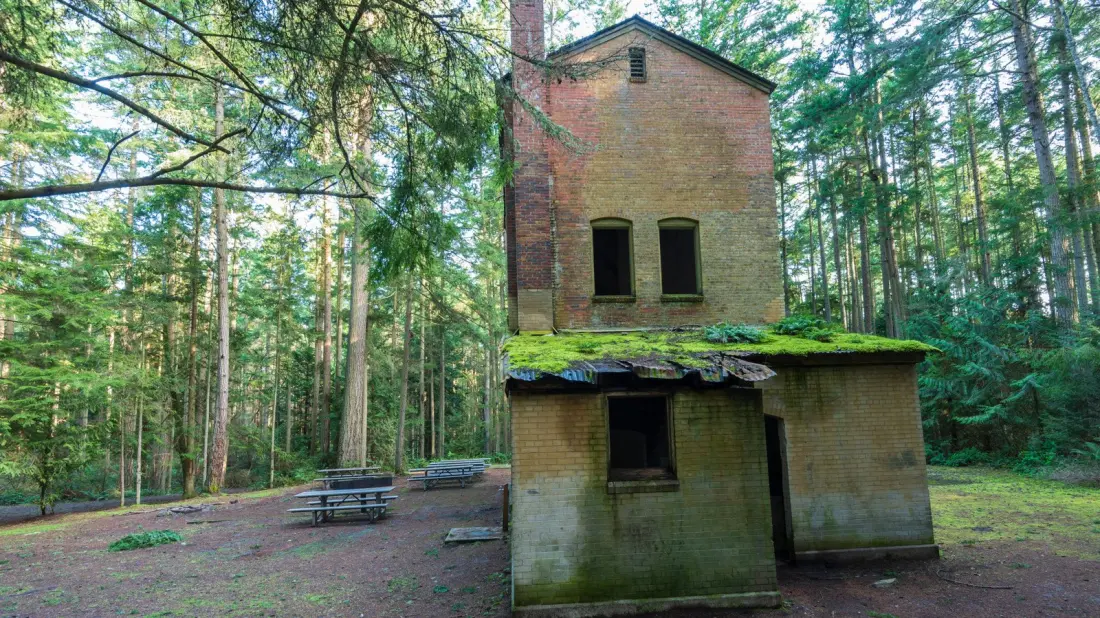
The trails are short enough to stack several into one day, and they double as a scavenger hunt through the park's past. The Cemetery Trail passes an abandoned military graveyard and ends at the Torpedo X-Ray Tower, a 65-foot brick structure where WWII torpedoes and mines were deactivated. An interactive historical walk traces the former parade grounds, with signs marking where buildings once stood, and the Friends Barn — a replica military stable — can be rented for events.
The bay adds a whole second layer. The park has 3,960 feet of shoreline for fishing (chinook, coho and pink salmon are the usual targets, with halibut in deeper Admiralty Inlet — a state fishing licence required), plus boating, scuba diving and beachcombing. Divers tend to head a bit north to the underwater park by the Port Townsend Marine Science Center, where giant Pacific octopuses and historic artefacts are on the menu. One etiquette note: the beaches are for looking, not pocketing shells.
Timing matters more than you'd think. Late spring brings rhododendrons, fairy slippers and ghost plants along the Botany Trail; autumn delivers a fungi show of fairy fingers and devil's tooth. Wildlife ranges from Douglas squirrels and salamanders to the occasional cougar, so basic trail awareness applies.
Who's this for? Anyone wanting a low-key Pacific Northwest escape that mixes light hiking, water sports and a bit of history without crowds. It's about 53 miles from Seattle via ferry, or 108 by road. If your dates fall outside camping season, the Victorian seaside town of Port Townsend has historic hotels nearby, and Fort Worden Historical State Park — seven miles away — keeps its Beach Campground open through winter.