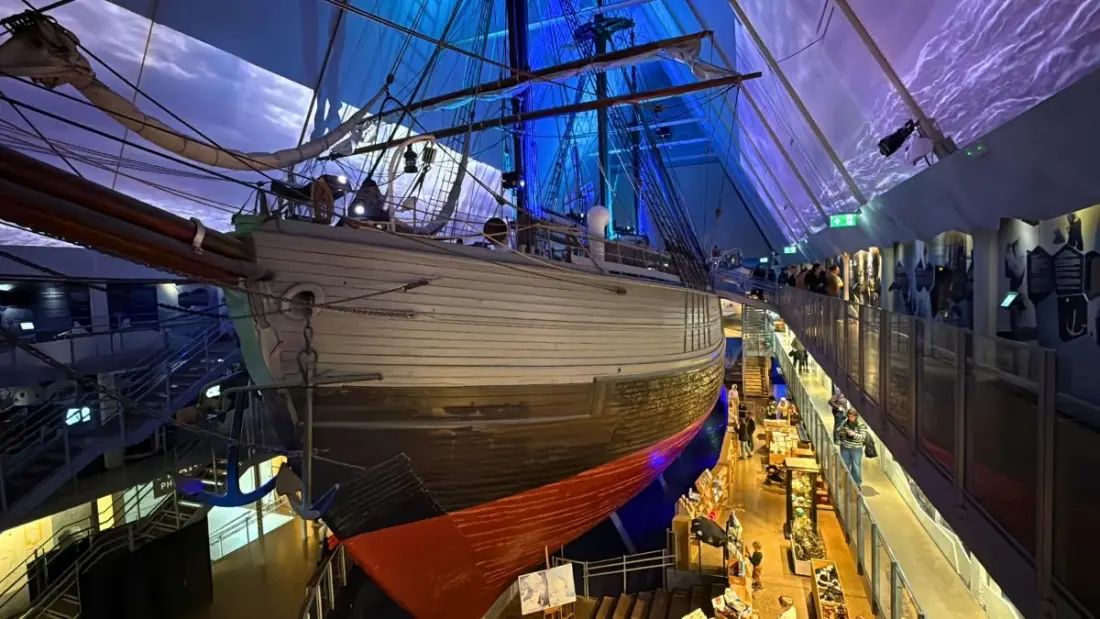
Most museums keep you behind a rope. At the Fram Museum on Oslo's Bygdøy peninsula, you walk in at ground level, look up at a towering black wooden hull — and then climb aboard the real thing. This is the original Fram, launched in 1892, a ship with arguably the greatest CV in polar history: it travelled farther north and farther south than any vessel of its era and carried crews on three landmark expeditions.
The story starts with a counterintuitive idea. In the 1880s, explorer Fridtjof Nansen noticed that wreckage from the American ship Jeannette, sunk near Siberia, had turned up near Greenland — evidence that currents carried ice right across the Arctic Ocean. His radical plan: let a ship get frozen into the pack ice deliberately and ride the drift towards the North Pole.
Shipbuilder Colin Archer made that possible. Fram's hull was unusually broad and rounded, with multiple layers of timber up to roughly 70cm thick, so ice pressure would push the ship up rather than crush it. The rudder and propeller could be raised for protection. The trade-off was a rolling, uncomfortable ride at sea — but Fram wasn't built for comfort.
It worked. Trapped near the New Siberian Islands in September 1893, the ship drifted across the Arctic for almost three years, surviving a terrifying ice-pressure crisis in 1895. Nansen and Hjalmar Johansen left the ship to sledge towards the pole, reaching a record 86°14′ north before wintering on Franz Josef Land. Fram emerged near Svalbard in August 1896 essentially intact.
The ship wasn't done. Captain Otto Sverdrup took it back to the Arctic from 1898 to 1902, mapping little-known islands in the Canadian Arctic in an underrated but scientifically rich expedition — and the Fram you see in Oslo today is presented largely in that configuration. Then came the boldest chapter: after Americans claimed the North Pole in 1909, Roald Amundsen secretly retargeted the South Pole. Fram carried his expedition to Antarctica, and on 14 December 1911 Amundsen and four companions beat Scott's British team to the pole.
By the 1920s the ship was rotting at Horten, and only a preservation campaign — chaired by Sverdrup himself — saved it. It was hauled ashore at Bygdøy in 1935 and the museum opened around it in 1936, which is why the building wraps around the vessel.
Today you can explore the deck, cabins, saloon, galley, cargo hold and engine room, plus galleries on the expeditions and a temporary photography exhibition covering Nansen's first voyage. Downstairs, a connected building holds Gjøa, the smaller ship Amundsen sailed through the Northwest Passage in 1903–06. Allow a good half-day.
Anyone with an interest in maritime history, polar exploration or just impressively stubborn engineering will love it — and it pairs easily with the other Bygdøy museums, including the Kon-Tiki, for a full Oslo day out.