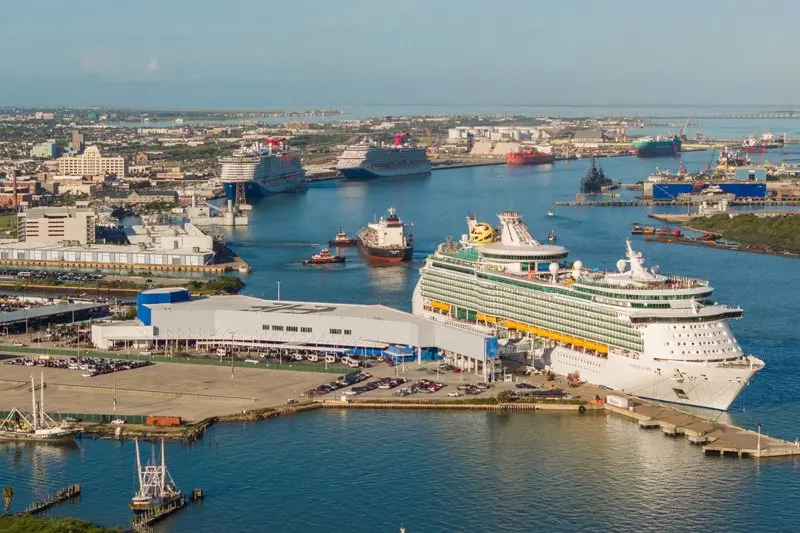
The Port of Galveston is quietly becoming one of the biggest cruise departure points in the United States — and it's now spending serious money to keep things that way. The port has announced a round of security improvements backed by $1,180,524 in federal grants from FEMA's Port Security Grant Program, topped up with the port's own funds.
Four separate projects are on the list. The largest, worth $802,100, continues cybersecurity updates and maintenance across the port's security systems. A $525,000 project adds video surveillance along access roads serving the cruise terminals and cargo areas. On a smaller scale, $88,925 will replace old mechanical locks with smart locks tied to a digital key management system — with controlled key issuance, digital tracking and audit trails. And a $158,009 project buys a mobile vehicle barrier system that can be rapidly deployed around critical infrastructure and public gathering areas whenever temporary vehicle restrictions are needed.
Port director and CEO Rodger Rees framed the spending as keeping pace with growth: as the port expands, security systems need to keep protecting facilities, tenants and the millions of guests moving through them. The port's security department handles everything from facility security and cybersecurity to personnel clearances.
Why does this matter to cruise travellers? Because Galveston isn't a bit player. Sitting at the entrance to Galveston Bay and the Houston Ship Channel, the port dates back to 1825 and now ranks as the fourth-busiest cruise homeport in the US, with four cruise terminals. For 2026 it projects 445 sailings and 3.9 million passenger movements — a new record. Major lines including Royal Caribbean, Carnival and Disney use Galveston as a home base for Caribbean and Mexico sailings, and much of that traffic comes from Texas and nearby states driving in rather than flying to a Florida port.
For anyone planning a cruise from Galveston in the next year or two, expect some construction-adjacent activity around terminal access roads as cameras and barriers go in, though the work is aimed at making arrivals smoother and safer rather than disrupting them. The practical takeaway is straightforward: this is a port investing in capacity and confidence at the same time, which usually bodes well for the embarkation experience. With 445 sailings on the 2026 calendar, there's no shortage of itinerary choice — from short Gulf getaways to week-long Caribbean runs — and the port's growth means more competitive pricing and departure dates for travellers in the region.
If you're sailing out of Galveston, build in a little buffer for the drive from Houston's airports (roughly an hour and a bit depending on traffic), and consider arriving the night before — a sensible move at any busy homeport, record year or not.
Story credit: Cruise Industry News.