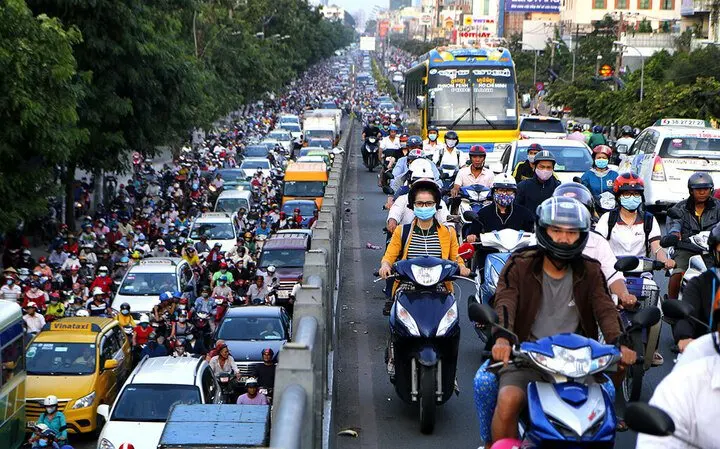
Ho Chi Minh City's traffic police have unveiled a package of proposals aimed at untangling the daily gridlock that clogs Vietnam's largest metropolis, and the headline measure is a ban on heavy trucks during rush hours.
At a press briefing on October 22, Lieutenant Colonel Hoang Ba Tuan, deputy head of the city's Traffic Police Division (PC08), said police are working with the Department of Construction and the Department of Justice on a new traffic safety resolution. It would raise fines for violations including illegal stopping and parking, and introduce a new decision replacing the 2018 rules that currently govern truck circulation in the city centre. Heavy-duty trucks would face restrictions during peak commuting times, with freight linked to industrial production shifted to night hours.
The proposals still have a way to go: the draft goes first to the municipal People's Committee, then to the People's Council for approval. But the direction is clear — the city wants its roads to prioritise commuters, with goods vehicles moving when everyone else is asleep.
There's more in the pipeline beyond the truck ban. Police have trialled upgraded traffic signal technology that they say has lifted junction capacity by 30%, with results reported to the city's police leadership ahead of a wider rollout. Joint task forces with the Department of Construction are also proposed for the worst pressure points: the area around Tan Son Nhat Airport, the city centre, and Cat Lai Port, the sprawling terminal handling much of the region's shipping.
Separately, authorities are running a 100-Day Campaign to clean up vehicle registration data, targeting cases where one person is registered as owning multiple vehicles or where decommissioned cars past their service life are still on the road. Vehicles over 20 years old but still roadworthy will be flagged with safety warnings.
Even school hours are being looked at. With heavy rain and high tides regularly flooding streets, PC08 has asked the education sector to stagger dismissal times so parents have more flexibility, and support vehicles have been staged to help residents through inundated areas.
For travellers, this matters in a practical way. Anyone who has tried to cross District 1 at 5pm or get to the airport during a downpour knows how badly congestion can eat into a schedule. If the truck ban and signal upgrades take effect, journeys between the airport, the city centre and the riverside port areas should get more predictable — and night-time freight could actually mean quieter daytime roads for visitors. Until then, the standing advice holds: pad your transfer times, keep an eye on the rain forecast, and consider the metro line or ride-hailing apps for cross-town trips during peak hours.
Credit: Vietnam Insider