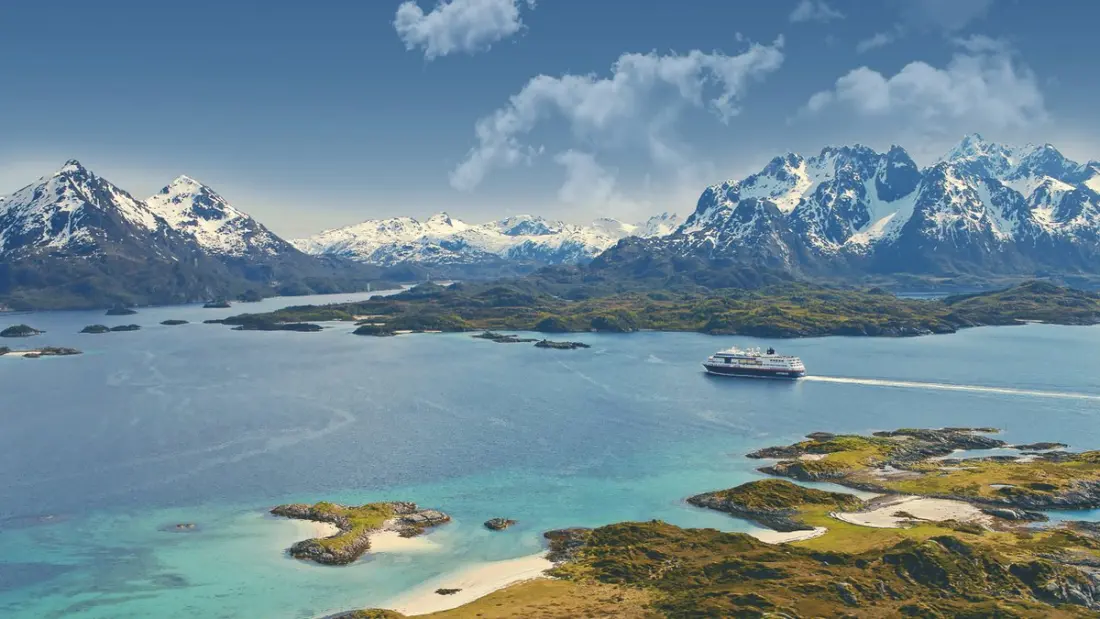
Hurtigruten has done something most cruise lines still only talk about: it sailed one of its regular, full-service ships from Bergen to Kirkenes — more than 5,000 km of the Norwegian coast — powered entirely by HVO100, a climate-neutral biofuel made from renewable waste materials, plugging into shore power wherever ports allowed. No test vessel, no modified prototype. MS Richard With carried paying guests on the company's classic coastal route, exactly as it does any other week.
That matters if you're weighing cruise options and wary of greenwashing. A sustainability claim proven on a normal working sailing with normal passengers is a very different thing from a pledge on a corporate slide. Carly Biggart, then Hurtigruten's Head of Americas, put it plainly: responsible travel isn't a trend, it's the future, and this voyage shows the industry can actually get there.
The biofuel trip sits on top of a decade of measurable progress. Per-guest CO2 emissions (Scope 1) are down 18% since 2018, fleet-wide total CO2 has dropped nearly 30% against the same baseline, and NOx emissions have fallen more than 69%. Those numbers give credibility to Sea Zero, the company's zero-emission ship programme targeting operation around 2030 — a relevant fact when only about 0.1% of vessels worldwide currently run on zero-emission technology. Sea Zero, developed with Norwegian research foundation SINTEF and 12 maritime partners on a budget of roughly €13 million (about €7 million publicly funded), aims to cut energy demand by 40–50% via retractable sails, air lubrication, contra-rotating propellers, large batteries and an AI-assisted bridge that optimises routing in real time.
There are honest limits, too. The battery-hybrid ships already in service can only charge where ports have the infrastructure — and in Norway, that's still patchy. Biggart acknowledged the company is sometimes ahead of the ports it calls at. Meanwhile, one of the most guest-relevant innovations isn't about emissions at all: AI-assisted navigation to help captains dock smoothly in rough weather, a real quality-of-life upgrade on a year-round coastal service.
What does this mean for the traveller booking a Norwegian coastal voyage? Essentially, that your cruise choice increasingly carries a verified environmental record rather than vague marketing. Hurtigruten publishes its ESG data openly and frames itself as a sector convenor, not just an operator — sharing learnings, failures included. Biggart's broader argument applies to the whole industry: travellers are increasingly after depth and meaning, not just volume and novelty. The future of tourism, she says, is about better, not more.
For smaller operators and anyone watching the adventure travel space, her advice is refreshingly unglamorous: start small, measure, and share openly — local sourcing, energy efficiency, guest education. Progress doesn't require perfection.
If you've been putting off Norway's famous coastal run because of its carbon footprint, the maths are changing faster than you might think — with a genuinely zero-emission ship potentially on the horizon by decade's end.