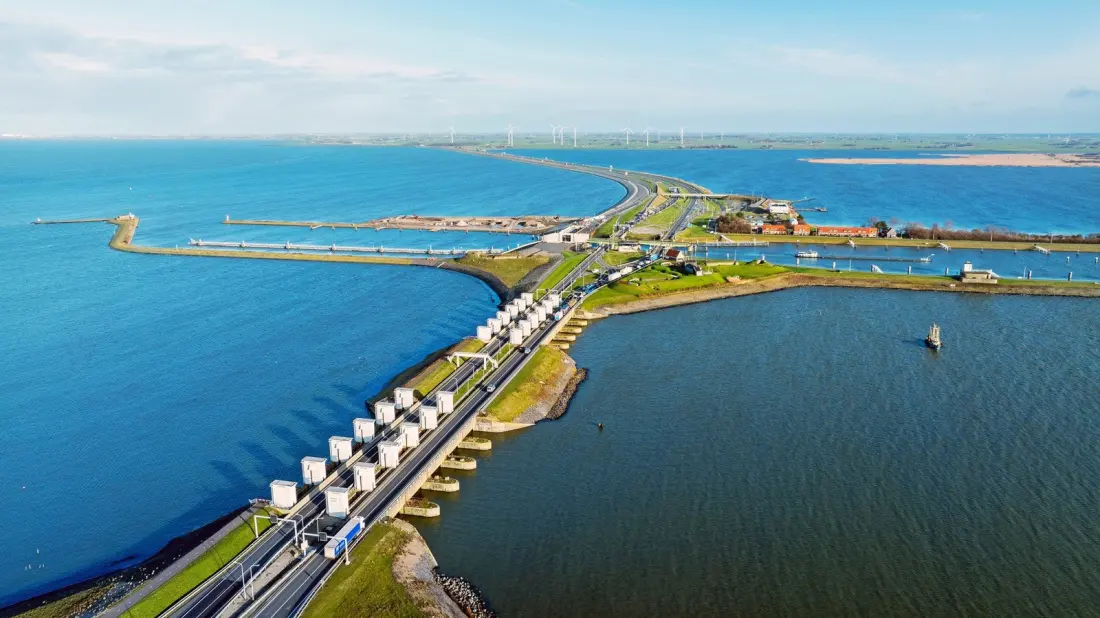
A century ago, the IJsselmeer didn't exist. The water here was the Zuiderzee, a stormy North Sea inlet that had swallowed Dutch land since Roman times. After the devastating flood of 1916, engineers built the Afsluitdijk, a causeway completed in 1932 that sealed the inlet off from the sea. Saltwater was gradually drained out, the IJssel River filled the basin with fresh water, and a lake was born — one that today is still the largest in the Netherlands, covering around 460 square miles after land reclamation and a second dam (the Houtribdijk) split it into the IJsselmeer and Markermeer in 1976.
The result is an odd and rather brilliant holiday landscape: an inland lake that behaves like the sea. With roughly 290 miles of shoreline and steady winds funnelling across shallow water, it has become one of Europe's top spots for windsurfing and kitesurfing. The Afsluitdijk blocks long ocean swells, so instead of classic surfing you get short, punchy waves — perfect "bump-and-jump" conditions. Towns like Makkum, with shallow water and reliable breeze, are ideal for beginners; Stavoren and Hindeloopen draw more experienced board riders on windy days.
Sailing is the other big draw. Boaters hop between the old Zuiderzee ports on multi-day trips, and while the lake is far calmer than the sea it replaced, conditions can still surprise you — a valid Dutch boating license is required to sail it yourself. No license? Guided cruises are the easy workaround.
The towns are half the appeal. Hindeloopen is known for its distinctive folk art — swirling florals and birds painted on furniture — plus traditional costumes that date back to the 17th- and 18th-century trade era. Stavoren is a classic harbour town, wrapped by water on three sides, with canals, nautical sculptures and brightly painted buildings. Lelystad sits on the Houtribdijk itself, mixing a reconstructed 17th-century merchant ship (the Batavia) with the Batavia Stad outlet mall, the country's first. Across the dam, Enkhuizen and Hoorn are among the Netherlands' most historic towns and easy day trips by boat or train from Amsterdam. And on the Markermeer side, the fairytale village of Marken — all old-school architecture on the water's edge — gives the lake its name and remains a favourite stop on sailing itineraries.
Who is this for? Travellers who want a water-based holiday without fighting North Sea swells, anyone who enjoys small historic Dutch towns beyond the Amsterdam circuit, and sailors, kitesurfers and windsurfers chasing consistent wind. It also pairs neatly with an Amsterdam trip: you can be on the lake within an hour, trading canal crowds for harbour towns you can genuinely sail or cycle between. Come in summer for warm-water watersports, or shoulder season for quieter quays and softer light on those painted facades.