Cabin crew drama usually stays behind the galley curtain. On one Delta Connection flight this week, it got so bad that the pilots radioed ahead for backup — and the people they needed protecting passengers from were the flight attendants themselves.
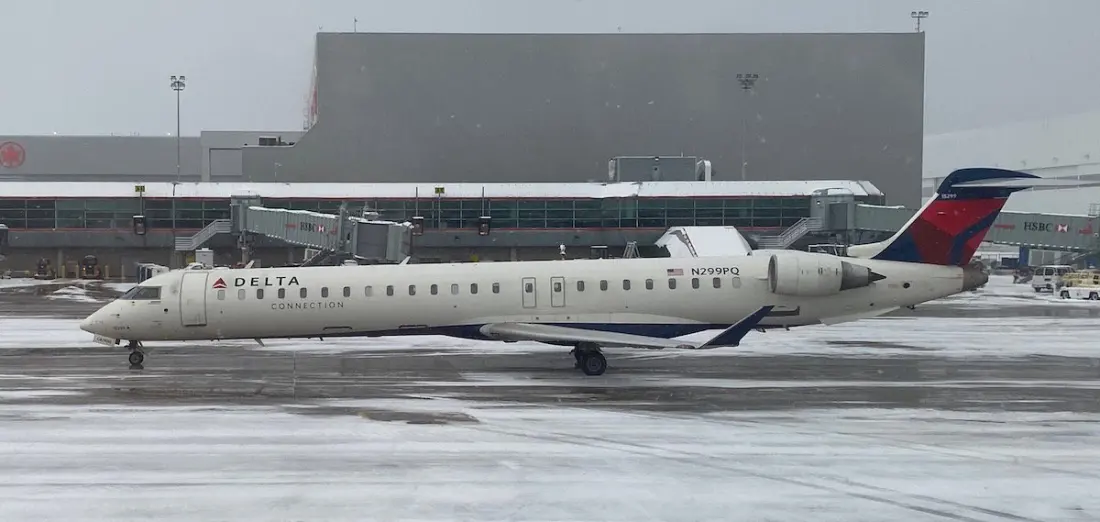
The flight in question was DL5090, a Delta Connection service operated by Endeavor Air on October 13, 2026, running from Greenville-Spartanburg in South Carolina to Detroit Metro. On paper it went fine: the CRJ-900 departed on time and landed early. But during the approach, the pilots contacted ground operations with an unusual request — they wanted an inflight supervisor waiting at the gate in Detroit.
Their reasoning, as relayed to the operations team: the crew was experiencing conflict issues among the flight attendants and would likely need to separate them to prevent further escalation or an incident.
Here's the kicker. A CRJ-900 carries exactly two flight attendants. That means the entire cabin crew — both of them — were in some kind of feud, on a flight of roughly 80 minutes, to the point where the flight deck felt the need to get ground staff involved. The plane landed safely with no reported operational impact, and no details have emerged about what actually triggered the row. Since Detroit is a major base for Endeavor Air, the airline presumably had little trouble reshuffling the pairing for the next day. It's a safe bet the two attendants didn't work a second leg together that night.
If this sounds bizarre, crew clashes are less rare than you'd think. Pairings change constantly, so on any given flight you may have two people who have never met sharing a tiny workspace for hours. Sometimes they become fast friends; sometimes they grate on each other. The aviation industry even has a formal system — crew resource management — designed specifically to stop personality differences from interfering with the job, and it works the vast majority of the time.
It's not only cabin crew, either. Air New Zealand recently cancelled a flight after its two pilots reportedly fell out so badly during a layover that they couldn't fly together. And as any observer will point out, a blow-up like the Delta one generally takes two willing participants: one reasonable adult who gives the other some space can usually defuse things and file a report afterwards. Letting it escalate on an 80-minute regional hop — badly enough that the pilots notice and intervene — suggests something genuinely went sideways.
Why should travellers care? Mostly it's reassurance: the system worked. The pilots spotted a problem, the flight landed early, and a supervisor was on hand to sort out the crew situation at the gate. Passengers were never in danger, and the flight was arguably the least affected party. But it's also a reminder that the humans flying you to Detroit are, well, human — and that even on regional routes where crew have worked together for years, an unlucky pairing can turn a routine evening into an operational headache.
For the rest of us, the practical takeaway is simple: nothing to see here, keep your seatbelt fastened, and be glad the most dramatic thing in your cabin is a middle-seat argument over the armrest.
Story first reported by One Mile at a Time.