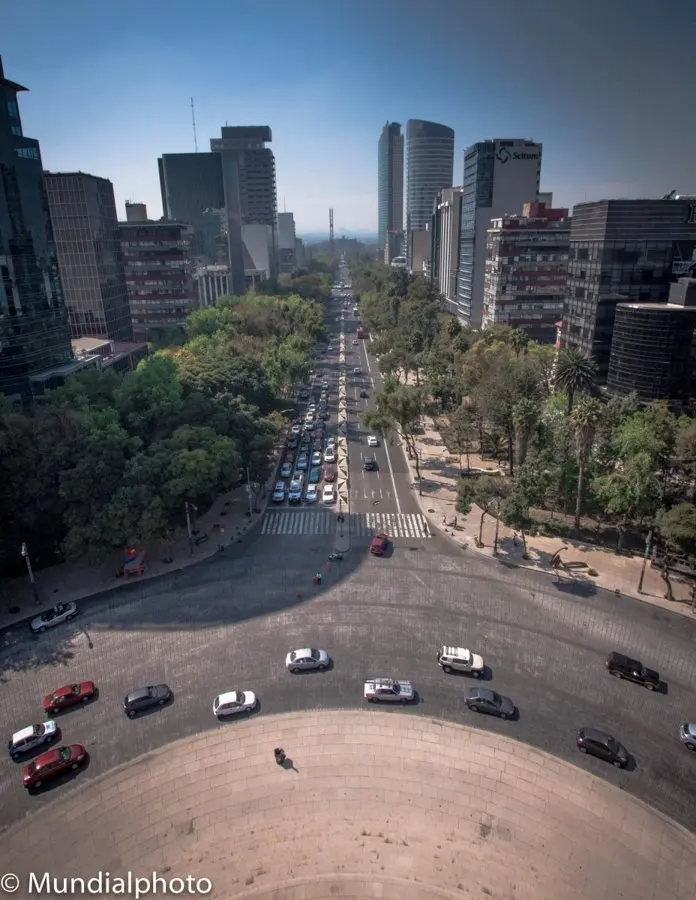
A few streets in the world pack as much history into one straight line as Paseo de la Reforma in Mexico City. Locals just call it Reforma, and it runs from the historic downtown all the way out to Chapultepec Park, slicing through the capital's main business district and one of its busiest tourist zones along the way.
The avenue began life as a royal commute. Emperor Maximilian had it built so he could travel between Chapultepec Castle and the National Palace downtown, and he named it Paseo de la Emperatriz after his wife Carlota — who, by most accounts, handled a good share of the decision-making at the castle. After Maximilian's defeat, the road was renamed in honour of the reforms of President Benito Juárez, and the name stuck.
Most of the monuments travellers photograph today arrived later, under the long dictatorship of Porfirio Díaz. The most famous is the Angel of Independence, inaugurated in 1910 for the centenary of the independence war and still the city's go-to celebration spot. There's also a statue of Cuauhtémoc, the last Aztec emperor, and one of Christopher Columbus. Later additions include the Diana fountain from the mid-20th century and, most recently, the Estela de Luz — a bicentennial monument meant to be ready for the 2010 celebrations that missed its deadline and stirred up controversy over its design and cost. It stands across the road from the Torre Mayor, which alongside the neighbouring Torre Reforma ranks among Latin America's tallest buildings.
Reforma today is a mix of eras: glass skyscrapers, hotels and gridlocked traffic sit alongside fountains and monuments, and the paseo tradition survives. At the Chapultepec end, you'll find the National Museum of Anthropology, the Museum of Modern Art and Chapultepec Zoo — notable as the first zoo outside China to breed giant pandas in captivity.
The best time to experience the avenue, though, is a Sunday, when stretches of Reforma close to cars and fill with cyclists and runners taking over the road. It turns a busy arterial route into one of the city's biggest public spaces, and walking or riding it car-free is arguably the best way to appreciate the monuments up close.
For visitors, Reforma works as both a sight and a base: plenty of hotels line the boulevard, and it connects two essential areas of the city — the centro histórico and Chapultepec — in one walkable or rideable sweep. Whether you come for the Angel, the museums or just a Sunday spin down a closed-off avenue, Reforma remains what it was always meant to be: a place for a stroll.