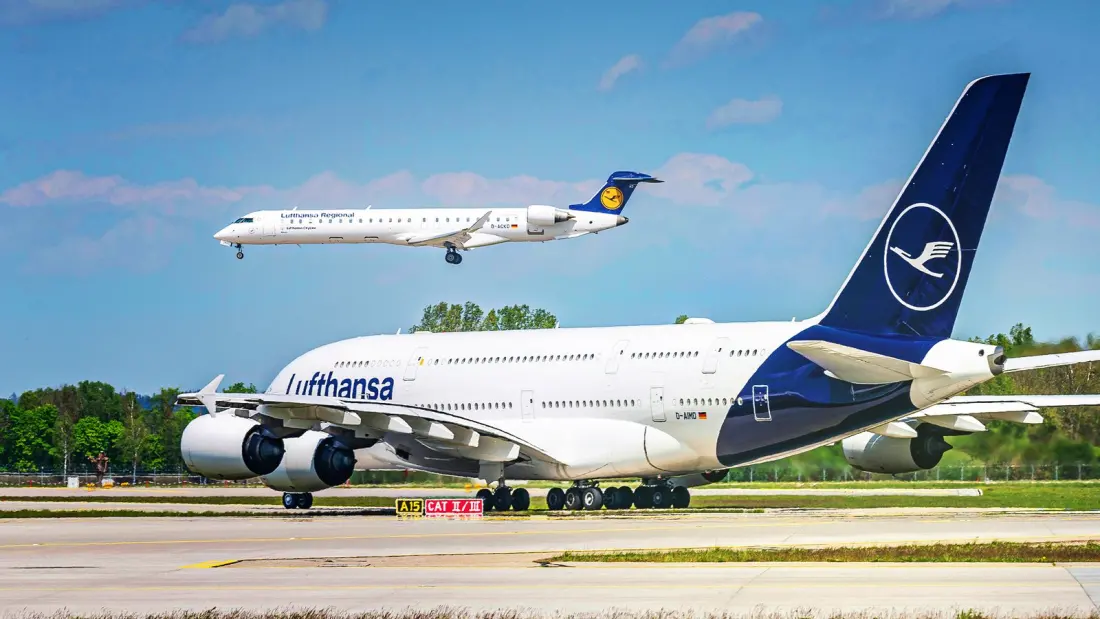
Most airline groups pour everything into one mega-hub. Lufthansa Group runs the opposite play, spreading its network across four major airports in three countries — Frankfurt, Munich, Zurich and Vienna — and coordinating them like a single machine. For travellers, that structure quietly shapes which routes exist, how easy connections are, and what happens when things go wrong.
Frankfurt is the heavyweight: the group's global long-haul and freight engine, which handled 63.2 million passengers in 2025. That was up 2.6% on the year before, but still about 10% short of pre-pandemic levels. Munich, its southern partner, moved 43.4 million passengers — a 4.4% jump that puts it at 91% of its 2019 record — with roughly 42% of travellers connecting through the joint-venture Terminal 2. Both German hubs are feeling the squeeze from congestion, night-flight caps and high costs, which is why the group's central Hub Steering Board trimmed short-haul capacity there for summer 2026.
Zurich tells a different story. Home to SWISS, it trades raw scale for yield, drawing on a wealthy Swiss catchment of banking, pharma and tech customers. In 2025 it hit a record 32.6 million passengers, finally passing pre-pandemic levels for a full year. Its compact terminals link straight into the national rail network, keeping minimum connection times remarkably short — handy if you're transferring between Schengen and non-Schengen flights.
Vienna, Austrian Airlines' base, leans on geography. It's the natural gateway between Western Europe and the Balkans, Eastern Europe and parts of the Middle East, and it also hit a record of about 32.6 million passengers in 2025. The outlook is bumpier: volumes are expected to dip to around 30 million in 2026 as low-cost carriers cut flights there.
The coordination behind all this is the real news. The group's Hub Steering Board now schedules across FRA, MUC, ZRH and VIE — plus Brussels and Rome Fiumicino — as one network. With jet fuel prices doubling since the Iran conflict began, the group scrapped 20,000 unprofitable short-haul flights through October 2026, cutting mostly at Frankfurt and Munich while adding capacity in Zurich, Vienna and Brussels.
Why should a holidaymaker care? Because a four-hub system is a built-in safety net. If strikes, weather or air traffic control caps shut down one hub, your connection can often be rerouted through another — the kind of resilience single-hub carriers simply can't offer. It also means schedules and routes will keep shifting as fuel costs move, so if you're booking Lufthansa, SWISS or Austrian for summer 2026, it's worth checking connection options across more than one of their gateways before settling on the obvious one.
Credit: Simple Flying