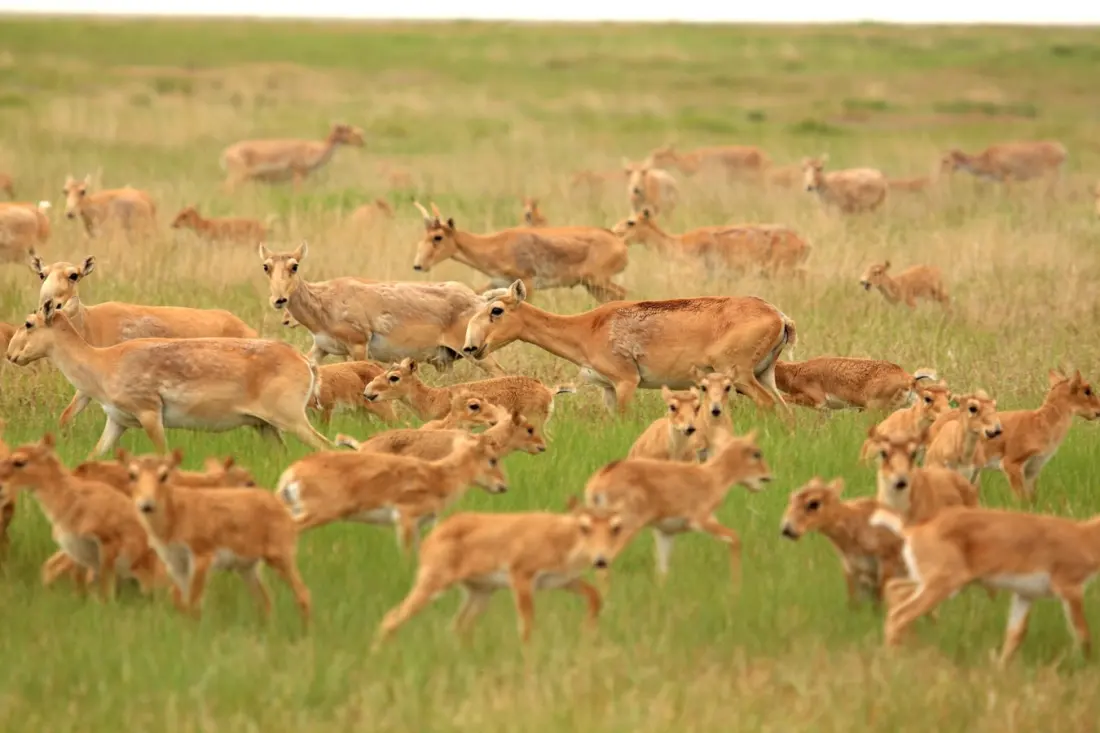
Kazakhstan and Uzbekistan signed a memorandum of understanding on November 12 to protect and restore the saiga, the critically endangered steppe antelope famous for its bulbous, trunk-like nose. Signed by Kazakhstan's Ecology Minister Alibek Kuantyrov and Uzbekistan's ecology committee chair Aziz Abdukhakimov, the deal commits both countries to joint monitoring of saiga numbers, migration patterns and health, satellite tracking, shared scientific data, and veterinary surveillance.
The transboundary angle matters because saigas don't respect borders. Every winter they migrate south in search of pasture when deep snow makes grazing difficult — in late December 2025, an estimated 60,000 to 65,000 saigas moved into the Syrdarya area of the Kyzylorda Region, with more than 30,000 concentrated in the Aral district alone. The memorandum plans joint anti-poaching patrols, transboundary protected areas, and dedicated migration corridors, plus a reintroduction programme to bring saigas back to their historical habitats by restoring pastures and water bodies.
The numbers tell a genuine conservation success story — with caveats. Kazakhstan holds three saiga populations: Ural, Betpak-Dala and Ustyurt. A spring 2025 census counted nearly 4 million animals (2.3 million Ural, 1.6 million Betpak-Dala, 78,000 Ustyurt), and separate data that April put the total at a record 4.1 million. That's a staggering recovery, but officials caution it's fragile: harsh winters can wipe out huge numbers, as happened in 1992 when deep snow killed so many saigas the population collapsed to roughly 15,000.
Organisations like the Association for the Conservation of Biodiversity of Kazakhstan (ACBK), the country's largest conservation NGO, run the Altyn Dala Conservation Initiative, using satellite telemetry to map saiga movements and flag where protection is needed.
Why should travellers care? The Central Asian steppe is one of the world's least-visited great wildernesses, and the saiga — a Ice Age survivor that once ranged from Britain to Mongolia — is its most eccentric resident. The Altyn Dala area and Kyzylorda Region are emerging as destinations for wildlife-focused trips, and growing herds mean better odds of actually seeing one. This agreement signals that both governments are serious about long-term protection, which bodes well for sustainable wildlife tourism in the region. For anyone drawn to off-the-beaten-track nature travel, Kazakhstan's steppes are quietly becoming a legitimate alternative to more familiar safari circuits.