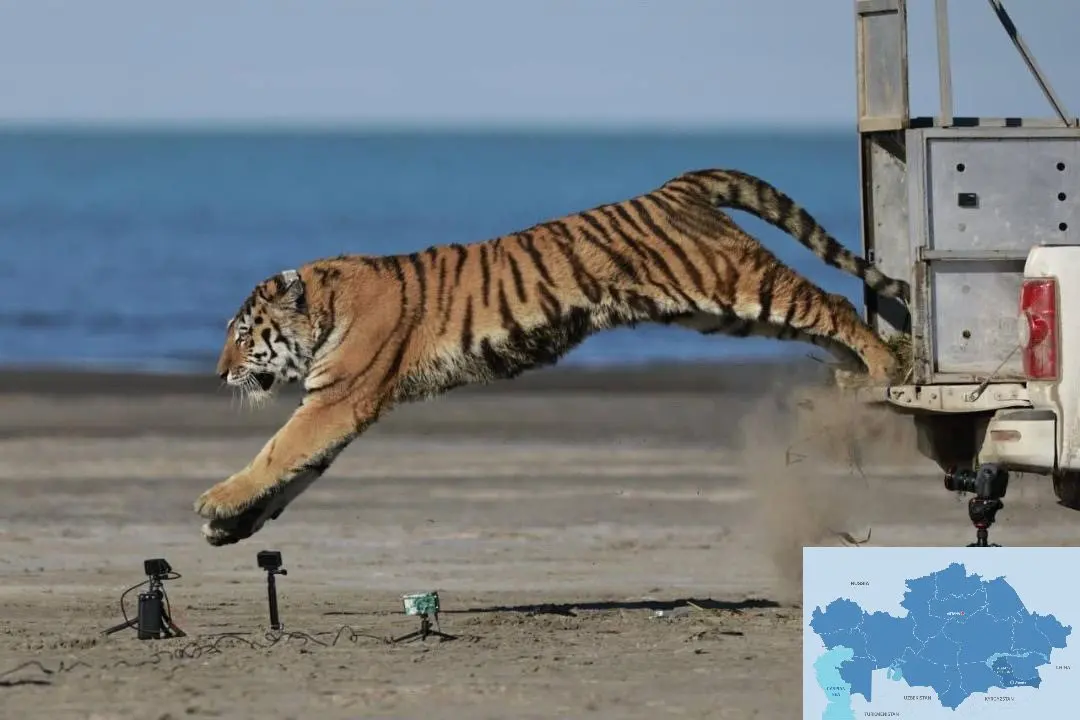
Kazakhstan now has two tigers living wild again after a gap of more than 70 years. On October 31, a male Amur tiger named Amur was released into the Ile-Balkhash State Nature Reserve, following a female called Umit, set free at the end of July. Both animals wear satellite collars so specialists can track how they settle in, and early reports say Umit is already hunting on her own.
The animals came from Russia's Khabarovsk Territory in May 2026 — two adults and two cubs, all caught in the wild. Genetic research shows the extinct Caspian (Turanian) tiger, which once roamed the Ili River valley and the shores of Lake Balkhash, was closely related to the Amur tiger, making the Russian subspecies the right choice for the programme. The two cubs are still in acclimatisation enclosures and will be assessed before any release.
This is not a quick photo-op conservation stunt. Kazakhstan created the reserve in 2018 specifically to rebuild the ecosystem tigers need: restoring tugai forest and floodplain habitat and boosting prey numbers. Bukhara deer and kulans have been relocated there, including 30 kulans moved from Altyn-Emel National Park in September 2026. The idea is a self-sustaining breeding population in the Ili River delta and southern Balkhash region, not just a few showcase animals.
There's a human side too. A dedicated anti-conflict team monitors the tigers, liaises with local herders and villagers, and responds to incidents — part of why reserve staff stress that community safety sits alongside conservation. Backers include WWF, which signed a cooperation memorandum with Kazakhstan's ecology ministry in 2024, and Russia's Amur Tiger Centre.
For travellers, this puts an unlikely wildlife-watching prospect on the map. Kazakhstan rarely tops big-cat itineraries, but the Ile-Balkhash reserve — wetlands, riverine forest and semi-desert on the edge of Lake Balkhash — is becoming a genuine conservation story you can follow in real time. Even before tigers are realistically viewable (they won't be for years, and that's by design), the region offers kulan, Bukhara deer, rich birdlife and a frontier-feel landscape most visitors never see. Combine it with Altyn-Emel's singing dunes, now doubly relevant given the kulan translocation, or the Charyn Canyon further east.
Practical realities apply: access to the reserve itself is restricted and any visits should go through licensed operators or conservation-focused tours, so treat this as an emerging reason to plan a southern Kazakhstan trip rather than a guaranteed tiger safari. Wildlife tourism here is in its infancy, which is exactly the appeal — you'd be seeing the comeback at the beginning.