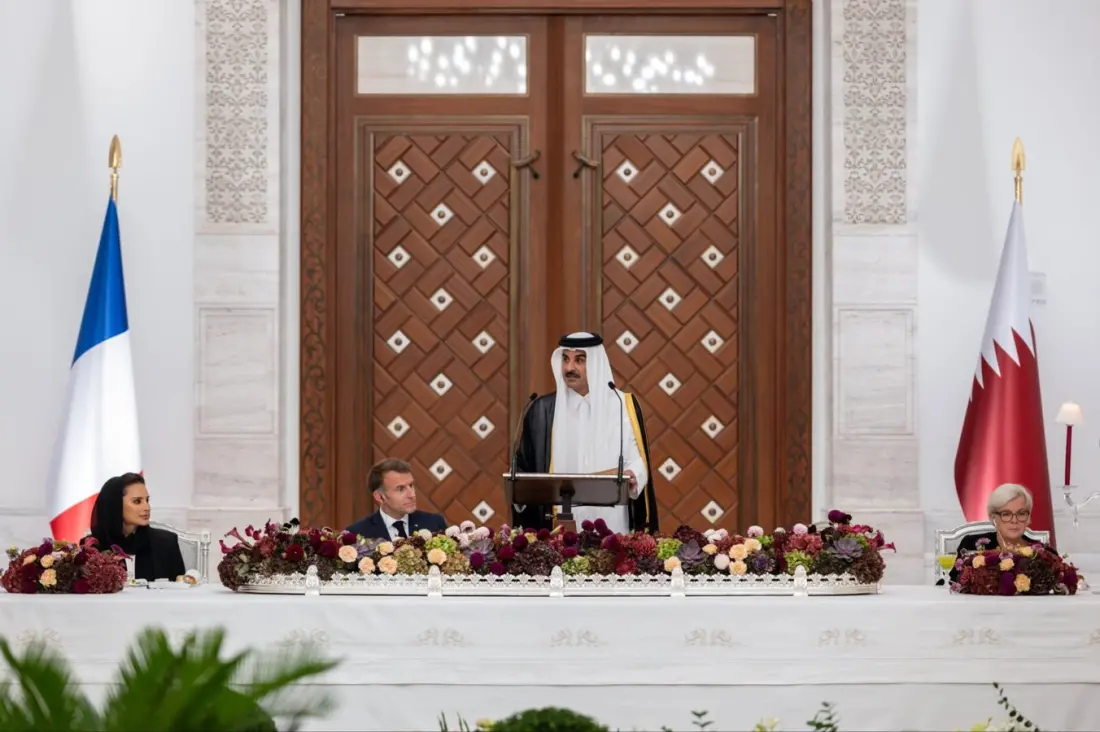
Emmanuel Macron has ended a two-day state visit to Doha — the first ever by a French president to Qatar — with a package of energy and defence commitments that underline how closely France and the Gulf are now tied.
The headline item for France is energy: Macron announced that Qatar will supply the equivalent of two terawatt-hours of liquefied natural gas per month over the winter, an arrangement Paris hopes will keep domestic energy prices in check as Gulf instability rattles markets. France has pursued similar supply deals with Saudi Arabia, Bahrain and the UAE.
Defence cooperation featured just as heavily. Talks covered upgrades to Qatar's fleet of Rafale fighter jets, new armoured vehicles and possible additional air defence and radar systems. Macron framed France as a natural partner for Gulf states looking to build up their own military capabilities, noting the relationship had deepened well before the recent regional conflict.
Diplomacy was the third thread. Macron praised Qatar's mediation efforts amid tensions between Iran and the United States, said France had stayed in contact with both Washington and Iranian President Masoud Pezeshkian, and reiterated a French proposal to reopen the Strait of Hormuz — a closure that would have major implications for shipping and air routes through the region. He cautioned that next steps depend on Iran's response in the coming days.
The ceremonial side of the visit was suitably grand. Macron landed at Hamad International Airport on Tuesday and was welcomed at Lusail Palace by Amir Sheikh Tamim bin Hamad Al Thani with a 21-gun salute, a traditional Ardah performance, mounted cavalry and camel units. The two leaders also attended the ninth One Planet Sovereign Wealth Funds summit in Doha, highlighting the investment side of the partnership, while the fourth annual Qatar-France Strategic Dialogue covered Gaza, Lebanon, Sudan and the Horn of Africa.
Doha was the final stop on a Gulf tour that also took in Kuwait, the UAE and Bahrain. For travellers with trips to Qatar or the wider Gulf booked, the takeaway is context: the region is diplomatically active and tensions with Iran remain the main variable to watch, particularly anything affecting the Strait of Hormuz and regional flight routes.