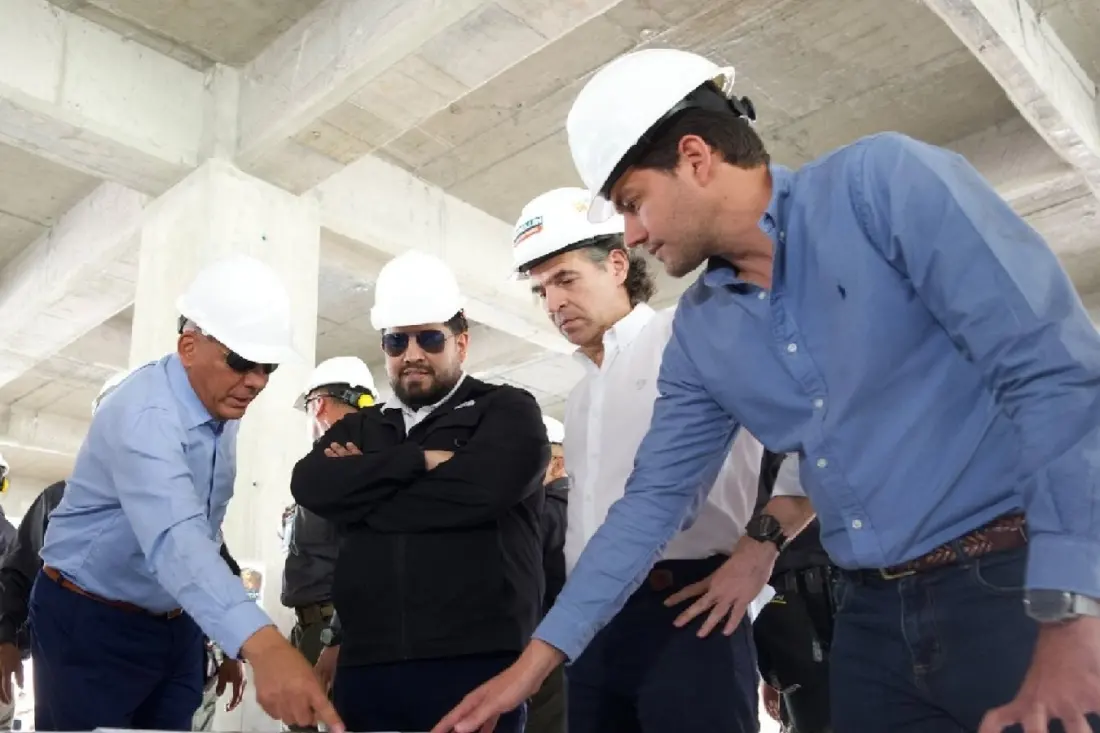
Medellin, a city long synonymous with drug cartels, is about to host one of the hemisphere's biggest counter-narcotics operations. US Deputy Secretary of War for Western Hemisphere Security Joseph Humire recently toured the construction site of a nine-storey building locally dubbed the 'Pentagon' — the future headquarters of the Shield of the Americas, the Trump-led initiative against terrorism and drug trafficking.
He was joined by Colombia's defence minister, retired General Jorge Eduardo Mora Lopez, and Medellin mayor Federico Gutierrez, who framed the project as a response to crime that no longer respects borders. 'The crime we are fighting is transnational,' Gutierrez said, pointing to drug trafficking, illegal gold mining and arms flows. Coordination between Colombia, the United States and 19 other countries in the Americas is already running; the building itself is not required for operations to begin.
Officially the Citizen Control, Computing, Communication and Contact Center (C5i), the complex will cover more than 18,000 square metres across nine floors and cost upwards of 205 billion Colombian pesos (about US$65.4 million). It is 36% complete, with a target opening of June 2027. Inside, it will house the Metropolitan Integrated Emergency and Security System (SIES-M), the Metropolitan Police dispatch centre for the Aburra Valley, and crisis-response rooms.
The tech pitch is ambitious: artificial intelligence, video analytics able to identify faces and licence plates, a data centre, cybersecurity systems and a platform pulling together information currently scattered across the mayor's office, police, army and prosecutors. The showpiece sits on the top floor — a vertiport for surveillance drones. The visit also confirmed the consolidation of the Americas Coalition Against Cartels (A3C), linking the FBI, DEA and HSI with Colombian authorities; floor labels for the FBI and DEA were already visible at the site.
What does this mean for travellers? Medellin has spent a decade reinventing itself as one of South America's most popular city breaks, and its image remains tied to security. This project signals that both Colombian and US authorities intend to keep transnational crime in check around a city that now welcomes millions of visitors. It should also, in theory, speed up emergency response — the centre will integrate citizen assistance lines covering mental health and women's protection alongside crime-fighting. Details on which US agencies will have a permanent presence and how operations will be coordinated are still to be formally spelled out.
For now, visitors will notice heavy security messaging around a landmark project in the making, with full operations expected by mid-2027. Nothing about day-to-day tourism changes immediately — but Medellin's transformation from cartel capital to security coordination hub is a story worth watching if you're planning a trip.
Colombia One