In the mid-1950s, Boeing engineers dropped heavy guillotine blades onto pressurised fuselage panels and sawed cuts into aircraft skin — on purpose. The programme, known as Operation Guillotine, was designed to answer a question the whole aviation industry was asking after a pair of deadly crashes: what happens when a jet's pressurised cabin gets damaged mid-flight?
The backstory is the de Havilland Comet. When it entered service in 1952 it was the world's first production commercial jet, but two aircraft broke apart in the air in 1954 — BOAC Flight 781 and South African Airways Flight 201. Investigators pinned the failures on metal fatigue. Each pressurisation cycle made the cabin swell slightly on climb and contract on descent, and tiny cracks around openings like windows grew with every flight until the structure gave way. The lesson was uncomfortable: an airliner that passed its initial strength tests could still fail months or years later.
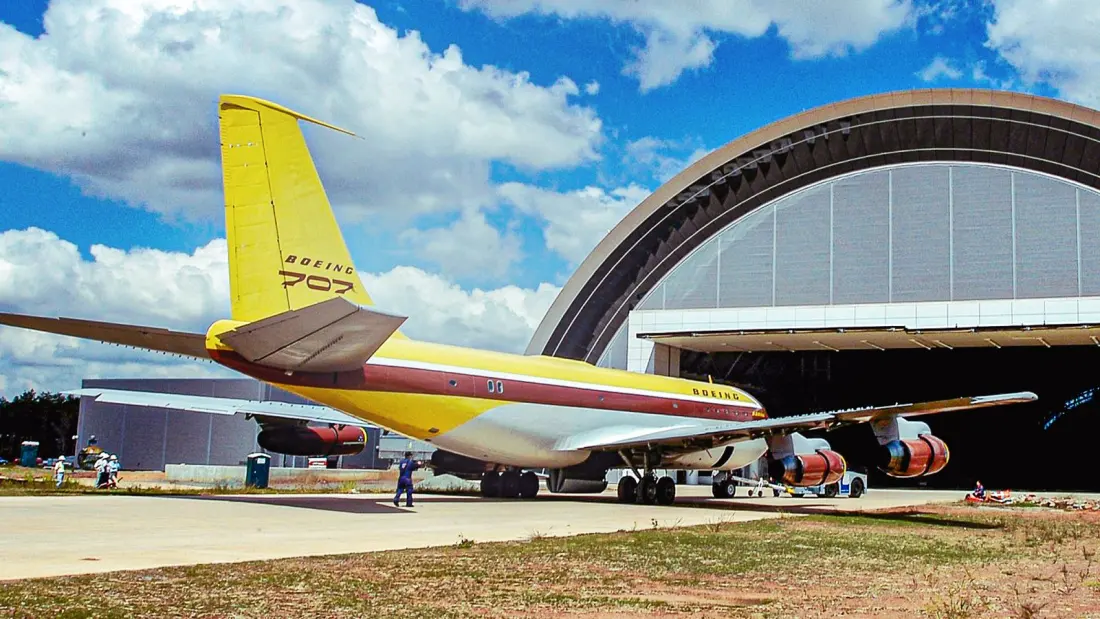
Boeing was racing to launch the 707 — swept wings, four jets, a pressurised cabin for long-haul routes — and needed to prove its fuselage could survive tens of thousands of those cycles, even with damage. From 1955 the company built large curved fuselage sections resembling the real thing, then attacked them. Early designs fared badly: blades punched through the skin and cracks raced across the structure. The fix wasn't simply thicker metal, but smarter load paths — notably tear straps under the skin and shear ties between components, positioned to stop a crack in its tracks. In the final configuration, panels survived seven blade drops without losing integrity, and saw cuts stopped dead at the reinforcing straps. Engineers designed for damage tolerance of at least one frame bay, roughly 20 inches.
Boeing also turned the testing into a sales film for airline executives, showing a conventional fuselage tearing apart under blade strikes while a reinforced 707 section shrugged them off with limited air leakage. For carriers weighing the switch from piston aircraft to jets — Qantas, Air India and Continental among them — that visible evidence of structural toughness mattered as much as speed or range.
The legacy is everywhere. Damage tolerance became a bedrock principle of airliner design, running through the 727, 737, 747, 757 and 767 and evolving into the sophisticated fatigue rigs and pressure tests used today. Modern composite fuselages like the 787 Dreamliner and Airbus A350 need different techniques than aluminium and tear straps, but the core goal is unchanged: keep localised damage from becoming catastrophe.
Why should a traveller care? Every long-haul flight you take involves a cabin pressurised to cruising altitude and depressurised on descent, thousands of times across an airframe's life. The reason you never think about it is the engineering that grew out of these destructive 1950s experiments — and the inspection regimes built on the same principle. The next time you glance out of a oval cabin window, you're looking at a design philosophy paid for in wreckage and guillotine blades.