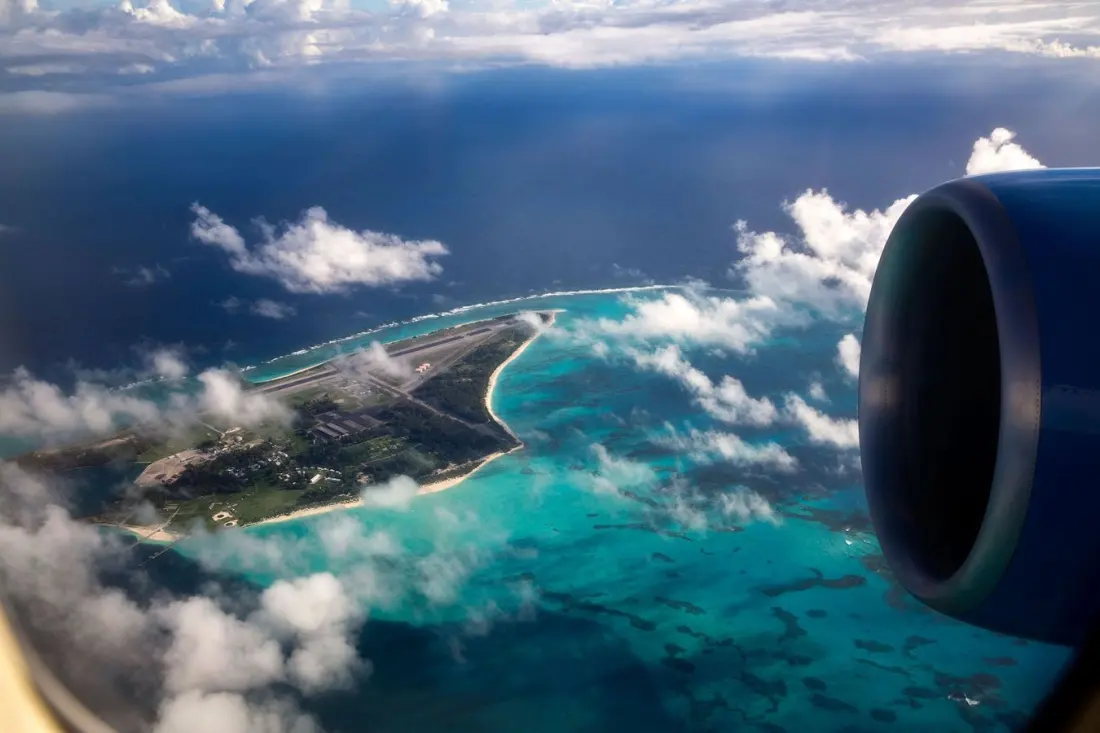
There's an airport in the middle of the Pacific that no airline flies to on a scheduled basis — yet tens of thousands of flights a year depend on it. Henderson Field on Midway Atoll exists mainly as an emergency diversion point, and it's now in trouble: the runway and seawall need more than $100 million in repairs, and if the airport loses its certification, transpacific routes could get slower and pricier.
Here's why a runway most travellers will never see matters. Two-engine jets flying over oceans operate under ETOPS rules, which require them to stay within a set flying time of a usable diversion airport. Midway sits almost perfectly in the middle of the Pacific for that purpose. In July, the US Federal Aviation Administration flagged the airport's deteriorating infrastructure and asked what would happen if it could no longer serve as an ETOPS alternate. The realistic fallbacks — Wake Island, Eareckson Air Station in the Aleutians, and Majuro in the Marshall Islands — cover some of the gap, but not all of it, and each has its own exposure to bad weather, volcanic ash and military activity.
The clearest example of the impact is Qantas's planned Sydney-to-London nonstop. Without Midway, the likely reroute via Wake Island would add roughly 20 minutes, burn an extra 2,200 kilograms of fuel, and force the aircraft to shed weight equivalent to about 22 passengers — over 9% of the plane's planned 238 seats. On an ultra-long-haul route with razor-thin economics, that could determine whether the flight is viable at all.
And this isn't theoretical. A United 777 with 348 people aboard diverted to Midway at night in 2014 on a Honolulu-Guam flight, and a Delta 747 with around 380 aboard landed there in 2011 after a cockpit windshield cracked. Part of Midway's value is reliability: a 20-year weather analysis cited by the Airline Dispatchers Federation found it below landing minimums just 3.7% of the time.
The airport isn't perfect. Its runway is 7,800 feet (7,400 usable in one direction), there's no control tower, and heavy bird activity limits daytime operations from November through June. It's run by the US Fish and Wildlife Service, with about $5 million a year combined from that agency and the FAA — far short of what the repairs require. Airlines get the benefit of the airport's existence without paying landing fees on the flights that never divert there, which is why the funding question remains unresolved.
For travellers, the takeaway is that nonstop flights between Australia, North America and Asia are planned around invisible infrastructure like this. If Midway drops off the list of approved alternates, expect longer flight times, tighter weight limits and possibly fewer nonstop options on some Pacific routes.