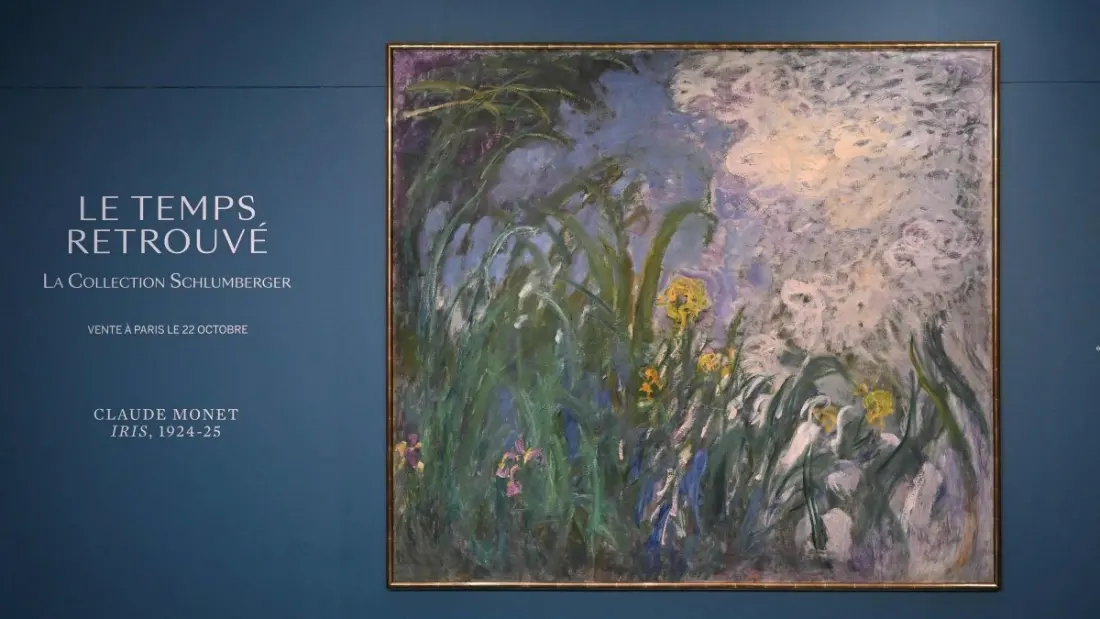
A painting that most of the world had only ever seen in black and white just made French auction history. "Iris", a monumental late work by Claude Monet, sold at Sotheby's in Paris for €50 million — about $56 million — including buyer fees, making it the priciest artwork ever auctioned in France. The estimate alone, €22-30 million, had been the highest ever attached to a painting offered at auction in the country, and the hammer blew past it.
What makes the sale remarkable is how invisible the canvas had been. Nearly two metres wide and 1.6 metres tall, it hung in the Paris mansion of the billionaire Schlumberger family for generations. Jeanne Schlumberger (1889-1983) acquired it, and it never once left the house in that time — known to scholars and enthusiasts only through an old photograph. Painted in Monet's twilight years, it surfaced now, fittingly, in a year marking the centenary of the artist's death on 5 December 1926.
"Iris" was the headline act but not the whole show. Three other Monets went under the same hammer at Sotheby's, including "Saule Pleureur" ("Weeping Willow"), valued at €9-12 million. Across town the same evening, Christie's moved 26 works for a total of €41.6 million — two Monets among them, with "Bord des falaises à Pourville" fetching €12.7 million and "Trois pots de tulipes" €3.1 million. A Renoir, "Jeunes filles au bord de la mer", took €5.8 million, and Picasso's "Nature morte au gruyère" sold for €3 million.
One twist came before the bidding even started: three Cézanne paintings listed as French "national treasures" were pulled from the sale hours ahead, after an agreement between their owners and the city of Aix-en-Provence. With backing from the culture ministry, the city hopes to buy the works and bring them back to the painter's hometown.
For travellers, the timing could hardly be better. The centenary is being marked in Paris with two exhibitions — "Monet, Painting Time" and "Stories of Landscapes, from Monet to Hockney" — so a city break in the French capital right now doubles as an Impressionist pilgrimage. Between the shows, the Musée d'Orsay and the Musée de l'Orangerie (home to the vast Water Lilies panels), Paris is the place to see Monet's late, loose brushwork in context. And if the auctions prove anything, it's that this work still grips people: half the city's collectors seem to be bidding, and everyone else can look for free on museum walls.
The record also nods to Monet's own country roots — Giverny, his house and water garden northwest of Paris, is an easy day trip and the natural companion to any centenary visit. One painter, one anniversary, and a very good excuse to plan a trip around it.
This story was first reported by Daily Sabah Travel.