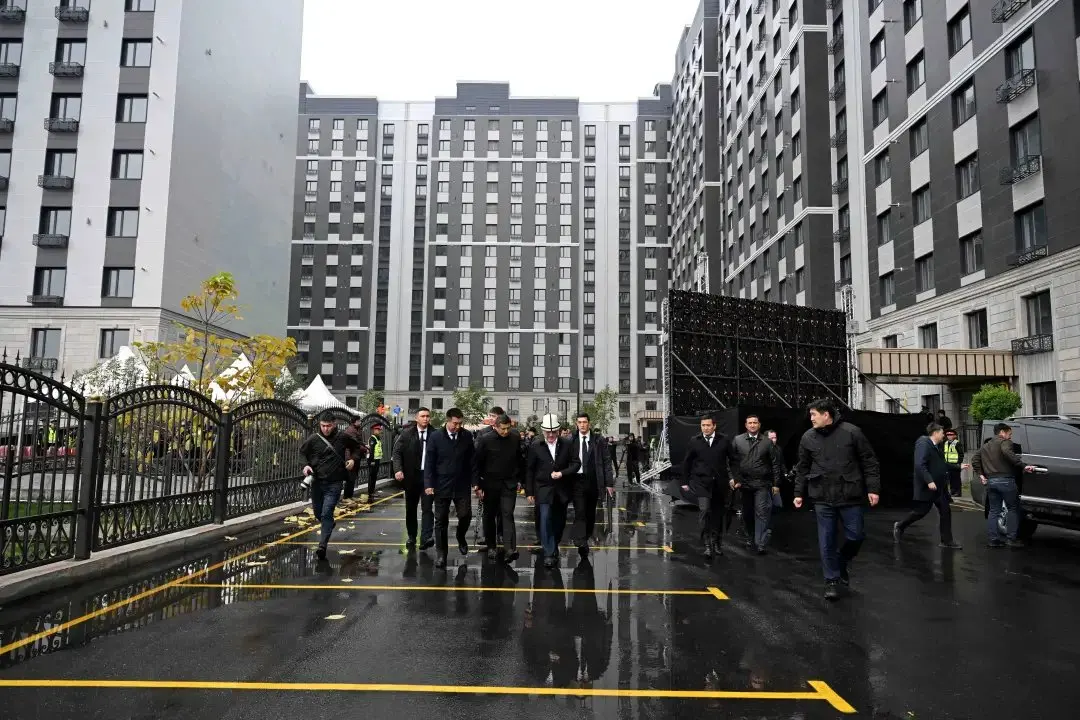
The southern Kyrgyzstani city of Manas, in the Jalal-Abad region, has just added almost 2,000 apartments in one go. At an opening ceremony attended by Head of the Cabinet of Ministers Adylbek Kasymaliev, the Asman Residence-7 complex handed over keys to hundreds of families buying through the state mortgage program. The complex has 12 blocks and 1,065 apartments.
Two more Asman developments were officially launched online at the same time: Asman-8 with 600 apartments, also in Manas, and Asman-14 with 312 apartments in the nearby Suzak district. Together the three complexes total 1,977 apartments.
The housing push was only part of a wider batch of 17 openings across Jalal-Abad region. Other new facilities include an additional building for Jalal-Abad State University, several schools, a feldsher-midwife station in the village of Gulistan, a brick factory in Bazar-Korgon district, and sports and cultural venues in Nooken and Suzak districts.
Why does this matter to anyone watching Central Asia? Manas is being positioned as Kyrgyzstan's second economic center, a goal President Sadyr Japarov has set. The big driver is the planned China-Kyrgyzstan-Uzbekistan railway, which officials expect to turn the city into a major trade, manufacturing and transport hub. If that line is built, it will be the first rail route cutting through the mountains linking the three countries, and it would put previously quiet southern towns like Manas directly on one of Asia's most anticipated transport corridors.
For travellers, none of this is a reason to book yet, but it is worth filing away. Southern Kyrgyzstan — Jalal-Abad, Osh, the walnut forests of Arslanbob, the hot springs around the region — is far less visited than the alpine lakes and trekking routes around Bishkek and Issyk-Kul. New housing, universities and rail infrastructure usually mean better roads, more transport options and more places to stay within a few years. Anyone planning an overland trip between China, Kyrgyzstan and Uzbekistan should keep an eye on the railway's progress; a through-rail route would significantly reshape how feasible that itinerary is.
The mood at the ceremony was domestic rather than touristic — Kasymaliev framed the build-out around families and state support, saying the country is being built "through strong families." But for a region that has long sat in the shadow of the north, this scale of construction is a genuine signal of where Kyrgyzstan's development money is heading next.