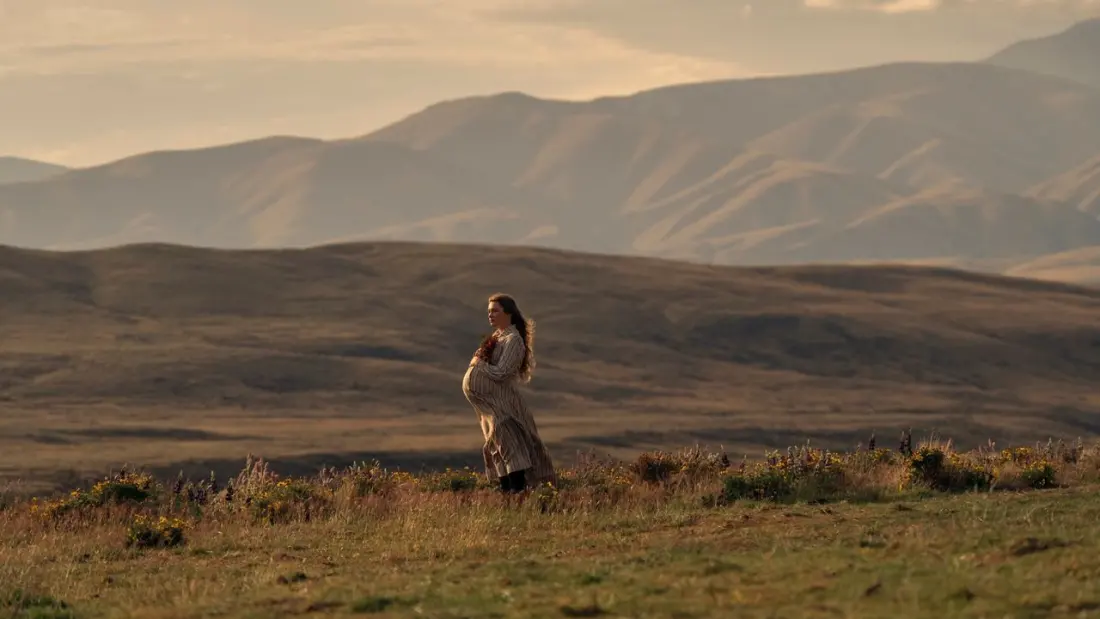
John Steinbeck's Salinas Valley, all dry foothills and waist-high grass, barely exists anymore — a century of development has erased the early-1900s farmland he described at the opening of East of Eden. So when Netflix set out to film its new adaptation, starring Christopher Abbott as settler Adam Trask and Florence Pugh as the magnetic Cathy Ames, there was no question of shooting in California. Instead, the production crossed the Pacific to New Zealand's South Island, a place that has quietly become Hollywood's go-to stand-in for a vanished American West.
Production designer Grant Major — an Oscar winner for The Lord of the Rings — says the brief for the Trask farm was simple: it had to look dry, since water is a constant struggle for the novel's settlers, and it needed a certain grandeur when Adam first lays eyes on it. The crew found both in the foothills of the Hawkdun Range in Otago. Crucially, the landscape needed no digital touch-ups at all. Major recalls wading through grass up to your waist just to reach the farmhouse, echoing Steinbeck's prose almost literally. It's the same farm he used for Jane Campion's The Power of the Dog.
The town scenes set in Salinas were shot in Oamaru, a seaside town of fewer than 15,000 people with a rare asset: a historic quarter of late-1800s limestone buildings, preserved from its days as a commercial port shipping goods worldwide. The real Salinas would have been brick and timber, but the team judged Oamaru's period streets, working railways and even a steam engine too good to pass up. Locals, Major says, embraced the production — though the town supplied everything except the brothels.
Those were handled in Auckland, where interior sets were built and the team tracked down a crumbling old mansion for the parlor scenes and exteriors. It wasn't luck: Auckland holds one of the world's largest collections of wooden Victorian houses, which is exactly why they found what they needed.
For travellers, this is a neat map for a South Island road trip. The Hawkdun Range country sits in Central Otago, an area of tussock grasslands and big skies near towns like Alexandra and Omakau, and it delivers the same rugged, empty-horizon feel in person that it lends on screen. Oamaru, on the east coast, is already a cult stop for its Victorian precinct, steampunk scene and blue penguin colony — the film is likely to send more visitors its way. And if you want to follow the American West theme further, Campion's The Power of the Dog drew on much of the same terrain.
Who should care: film-location hunters, anyone plotting a South Island itinerary beyond Queenstown, and Steinbeck fans curious to see how a lost corner of California was conjured from Otago farmland.