
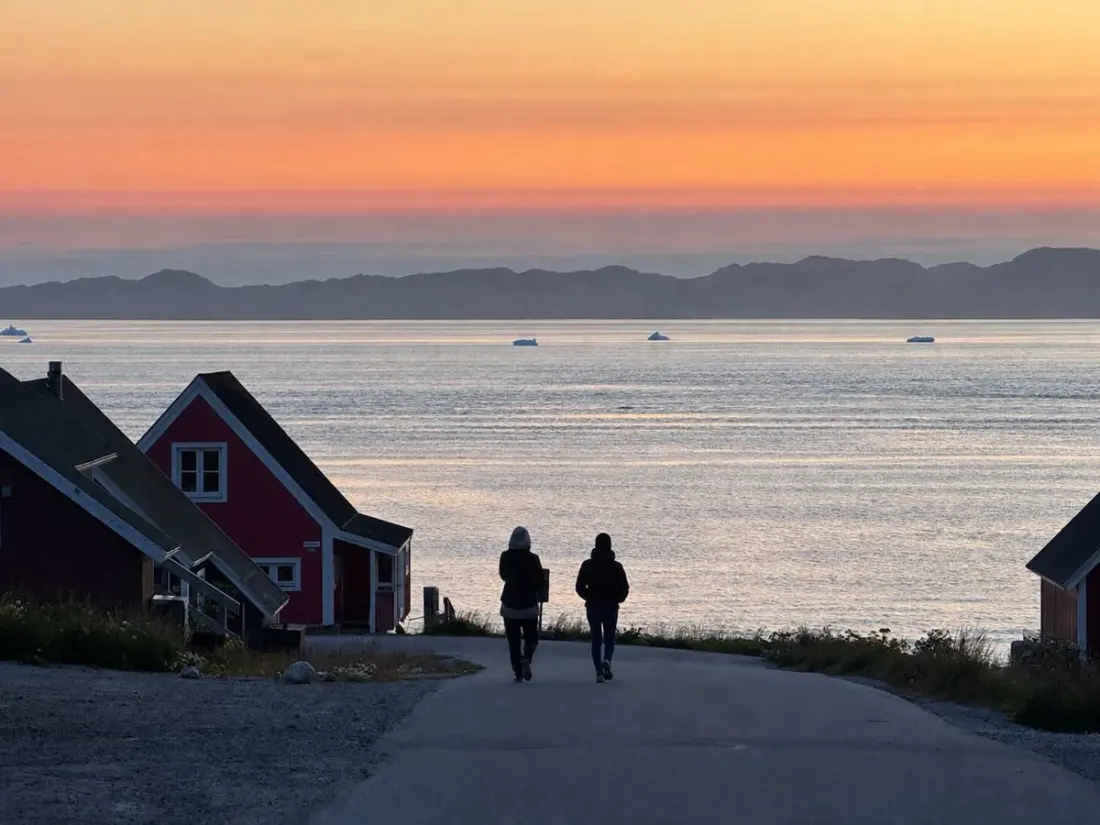
It's close to 11pm and the sky is still bright. That's the everyday magic of a summer evening in Nuuk, Greenland's small, colourful capital, where twilight lingers well past midnight and the city takes on a soft, golden calm that's hard to find anywhere else.
A walk from the centre down to the old harbour captures the city in miniature. Brightly painted wooden houses crowd the waterfront, backed by mountains and the cold water of the fjord. The most eye-catching landmark is Annaassisitta Oqaluffia, the Church of Our Saviour — a red wooden building completed in 1849 that now serves as Nuuk Cathedral and the seat of Greenland's Lutheran bishop. On the hill above stands a statue of Hans Egede, the Danish-Norwegian missionary who founded the colonial settlement in 1728 and named it Godthåb, "Good Hope." Nuuk, meaning "cape," only became the official name later.
Egede's story is worth knowing before you go, because it explains a lot about Greenland today. He arrived in 1721 hoping to convert Norse settlers — not realising those communities had vanished centuries earlier — and instead began missionary work among the Inuit. He brought Christianity and literacy, but he's also tied to Danish colonisation and the suppression of traditional Inuit culture. His hilltop statue has become a focal point in Greenland's ongoing debate about its history and identity, and you'll feel that tension in the city itself: old wooden homes next to modern apartment blocks, government offices, cafés and restaurants.
What surprises most visitors is how quickly the wild takes over. Walk a few minutes beyond the centre and the mountains and fjord dominate everything. The city has spread well beyond its historic core, but it remains compact enough to cover on foot — ideal for those long, slow summer evenings when there's no real reason to go indoors.
For travellers, the appeal is simple. Nuuk offers a capital-city break unlike any other: culture, history and Scandinavian-level comfort, with Arctic wilderness at the edge of town and daylight hours that stretch deep into the night from late spring to midsummer. It's a place for people who like their city breaks quiet, scenic and a little bit strange — where dinner can be followed by hours of walking in broad, low sunlight.