
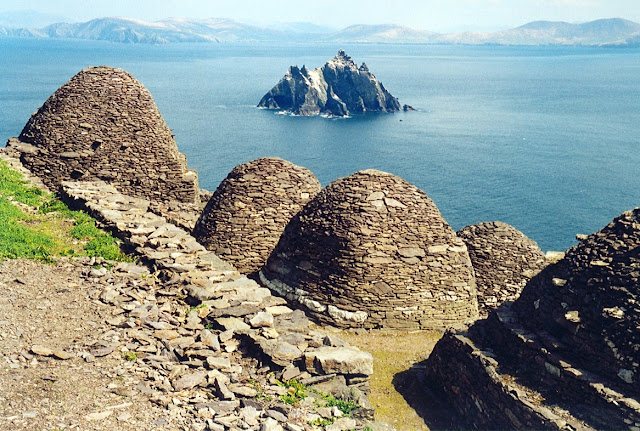
Nine miles off the County Kerry coast, sitting squarely in what most of us would call the Atlantic proper, Skellig Michael is one of Ireland's strangest and most moving sights: a jagged island topped by an early Christian monastery that functioned for some 800 years. Comedian, actor and writer Tommy Tiernan recently made the crossing, and a video of his visit captures just how deeply the place lands on people.
The first thing Tiernan encounters is the climb. The stone steps up to the monastery are brutally steep, cut into rock by monks well over a thousand years ago, and the ascent is not a pleasant stroll. But reaching the top, he's visibly struck by the beauty of the site — the beehive huts, the walls, and the sense of isolation pressing in from every side.
That isolation is the point, and the part that lingers. Tiernan and others have reflected on what winter must have felt like out there: cold, wind and waves with no mainland escape. The monastery's occupants chose this — no heating beyond a fire, no shops, no quick route home. Standing among the ruins today, it's hard not to wonder whether you'd last a day, let alone a lifetime.
The island is also a wildlife site of major importance, home to huge colonies of seabirds, which is one reason access is tightly controlled and seasonal. And yes — film fans will recognise the island from Star Wars, where it doubled as Luke Skywalker's hiding place, though the monastery predates any galactic drama by well over a millennium.
For travellers, the takeaway is simple: Skellig Michael is a rare chance to walk into an intact early medieval monastic settlement at the edge of Europe. But it rewards the prepared. Boats run only in the summer months from places like Portmagee and Ballinskelligs, landings depend entirely on sea conditions, and trips frequently sell out months ahead. If you can't secure a landing permit, boat tours that circle both Skelligs still deliver a spectacular look from the water.
Tiernan's visit is a good reminder of why the effort is worth it. The stairs are hard, the weather is fickle, and the cold is real — but the reward is one of the most atmospheric heritage sites anywhere in Europe, with puffins in summer and a silence you won't find on the mainland.