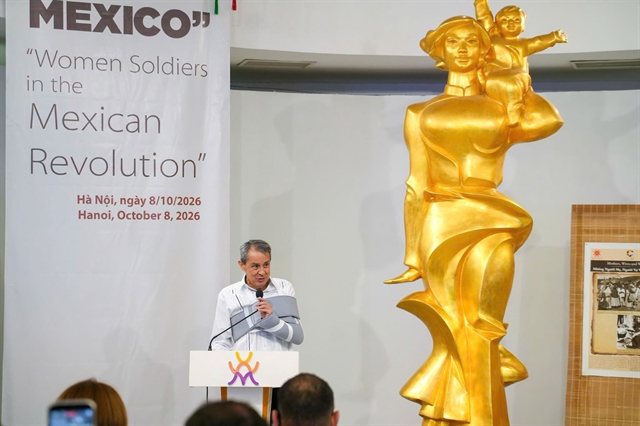
A slice of Mexican history has landed in the Vietnamese capital. The Vietnamese Women's Museum is hosting "Women Soldiers in the Mexican Revolution", a photo exhibition honouring the soldaderas — the female fighters who marched with revolutionary armies during Mexico's 1910 upheaval, the first major social revolution of the 20th century.
The images on display come from the late photographer Agustín Víctor Casasola (1874–1938), whose archive is one of the definitive visual records of the era. Far from being camp followers, the soldaderas appear in these frames as strategists, logistics organisers, nurses, journalists, activists and front-line combatants. Organisers describe them as among the most recognisable figures of the revolution — women who defended their communities, spread revolutionary ideas and reshaped views of their own place in society.
The exhibition opened on October 8 as part of celebrations marking 51 years of diplomatic ties between Việt Nam and Mexico, established in 1975. It is a joint effort between the Vietnamese Women's Museum, the Mexican Women's Museum and the Casasola Photography Collection, and it is the second time the two museums have worked together. Last August, the exchange went the other way: photographs of Nguyễn Thị Định, Việt Nam's first female general, and the Vietnamese "Long-haired Army" went on show in Mexico to a warm public response.
At the opening, museum director Nguyễn Thị Tuyết framed the show as more than a history lesson — it tackles wider questions of gender, conflict and peace, and celebrates women's resilience in the face of extraordinary adversity. Mexican Ambassador Alejandro Negrín said the collection helps Vietnamese audiences understand the revolution through the women who took part in it, while journalist and cultural activist Kyra Núñez de León, who championed the project, described the photographs as a way of sharing Mexico's memory and opening a dialogue between women of two countries with rich, complicated pasts.
For travellers, this is a neat reason to linger in Hà Nội beyond the usual circuit. The venue itself is one of the city's most interesting museums — its permanent displays on Vietnamese women's lives, from wartime roles to ethnographic traditions, pair naturally with a visiting show about women in another nation's struggle. The exhibition runs at 36 Lý Thường Kiệt Street until October 22, so anyone passing through the capital this month has a narrow window to catch it. Admission is inexpensive by international standards and the location is a short walk from the Hanoi Opera House and the Old Quarter, making it easy to fold into a day of city sightseeing.
Even if you arrive after closing day, the Women's Museum remains one of Hà Nội's most rewarding stops, and the growing partnership with Mexico suggests more cross-cultural shows could follow. If your trip coincides with the run, expect striking century-old photography, bilingual context panels and a quieter, more reflective museum experience than the city's big-name attractions.