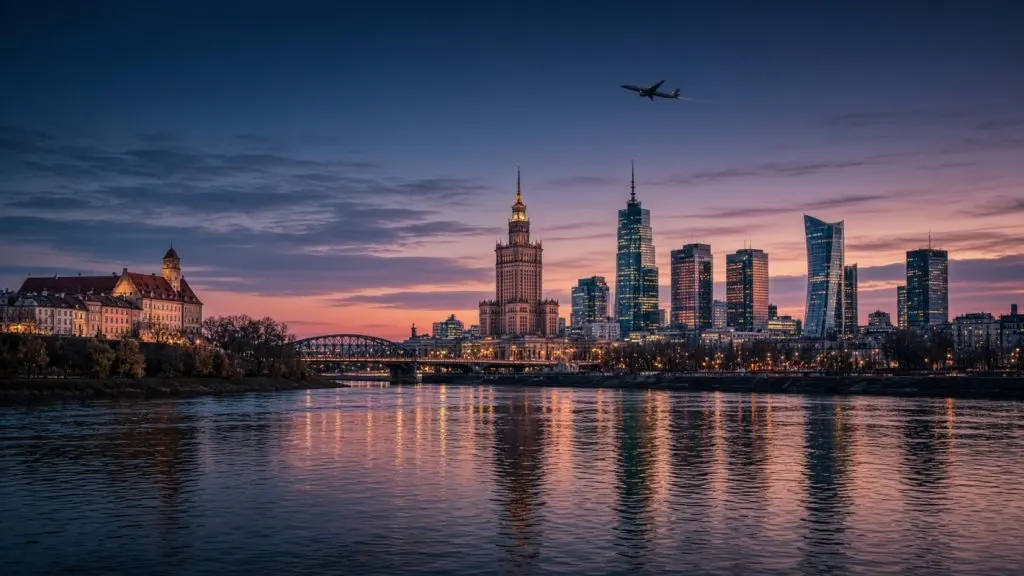
"The superstar, without even thinking about it, is Poland." That was Greg O'Hara, founder of investment firm Certares and one of the most influential figures in travel finance, answering a question at Skift's Transatlantic Summit in Dublin on October 15 about where he'd put money outside Western Europe.
His reasoning was refreshingly concrete. Poland ticks every box he looks for: a young, skilled workforce, strong engineering and training culture, and — crucially — its own currency. Unlike eurozone members, Poland's zloty gives the country room to steer its own monetary and interest rate policy, which has helped it navigate recent economic turbulence better than many neighbours. The result is an economy that has grown consistently while others stagnated, and a country where international investors keep doubling down.
But O'Hara didn't stop at spreadsheets. His second argument was about connectivity: in his view, Poland is set to become the centre of high-speed rail in Europe, with serious public spending flowing into rail lines, stations and airports. That matters for travellers as much as for investors. Better links mean Warsaw, Krakow, Gdansk and Wroclaw become easier to combine in one trip — and easier to reach from Berlin, Prague, Vienna and beyond.
The wider context backs him up. Poland has spent three decades transforming from post-communist economy into one of Europe's most dynamic, and its tourism infrastructure is catching up. Krakow has long been a city-break favourite, Warsaw has quietly built one of Europe's most interesting food scenes, and Gdansk's rebuilt Old Town rivals anything on the Baltic. Meanwhile, new airport and rail investment — including the long-planned CPK mega-airport between Warsaw and Lodz — signals that getting around is only going to get easier.
What makes this story worth watching is the timing. O'Hara's kind of money tends to arrive before the crowds do. Countries that attract serious infrastructure and hospitality investment usually see the payoff in hotel quality, flight routes and overall visitor experience a few years down the line. Travellers who get to Poland now — before the high-speed rail network and expanded airport capacity land — get current, still-reasonable prices on the front end of that curve. A long weekend in Krakow or a food-focused few days in Warsaw costs a fraction of a comparable trip to Vienna or Amsterdam, and the zloty often works in visitors' favour against the euro.
For holidaymakers, the practical takeaway is simple: Poland is no longer just a budget alternative, it's increasingly the main event. Expect more direct flights, better trains and smarter hotels over the next five years. Going sooner means seeing the country at its most authentic — and cheapest — stage of the boom.