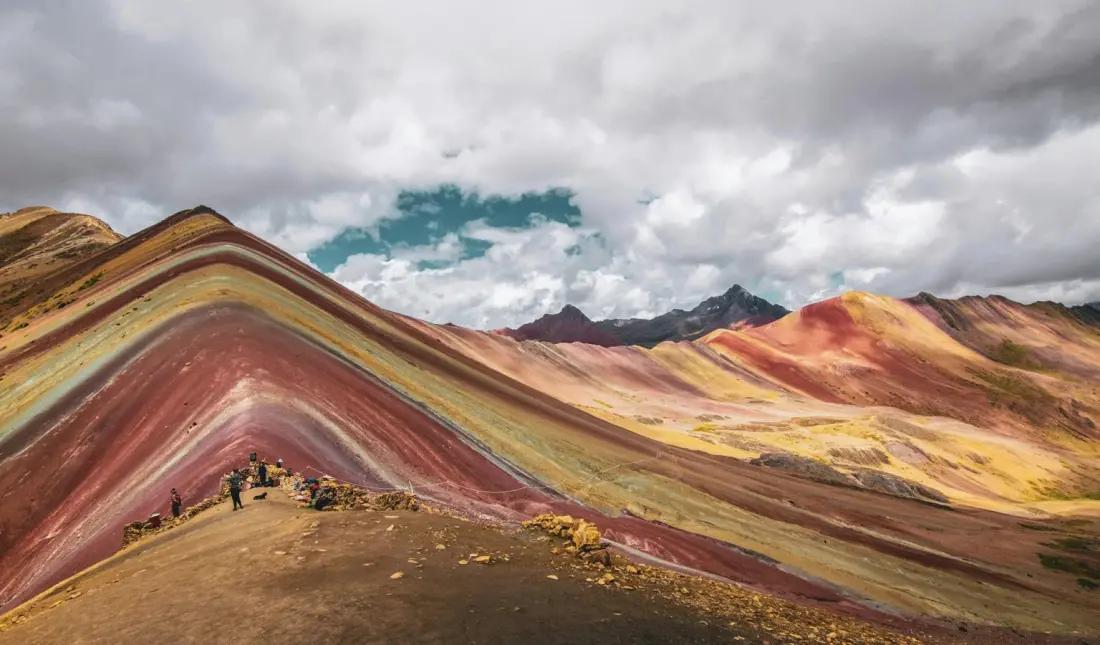
The stripes of pink, red, yellow and green sweeping across Peru's Rainbow Mountain look Photoshopped even in person. They aren't. The colours are the product of millions of years of sediment build-up, tectonic upheaval and plain old rusting rock.
Locals call it Vinicunca, the Mountain of Seven Colours, and it sits in the Vilcanota range southeast of Cusco. Its story starts in ancient marine, lake and river beds, where layers of clay, sand and mineral-rich sediment stacked up over vast stretches of time. When the Nazca Plate slid beneath the South American Plate, those layers were lifted and buckled as the Andes rose. Erosion then peeled back the surface and exposed the bands you see today.
The palette itself comes down to chemistry. Red and pink tones come from iron oxides like hematite; yellows and ochres from goethite and other hydrated iron oxides; greens from rocks rich in iron and magnesium. Purple and lavender layers are clay-heavy sediments, while white and cream bands trace quartz-rich sandstone and limestone. Iron is the recurring character here — when iron-bearing minerals meet oxygen and water, they oxidise into the reds, browns and yellows that give the mountain much of its character. Colour alone can't identify any given layer, but together the mineral mix produces one of the most striking natural sights in South America.
Interestingly, the mountain is a fairly recent star. It went viral around 2016 when travellers began posting photos online, and the retreat of snow and ice helped expose the colourful slopes in the first place. Climate change didn't paint the mountain, but shifting conditions made it visible. What you see also depends on the day: strong sun sharpens the contrast between layers, wet rock darkens, and snow can hide whole sections.
The practical part matters here. Vinicunca stands at roughly 5,200 metres, which makes even the short hike genuinely demanding regardless of fitness. Acclimatise in Cusco for a couple of days first, walk slowly, drink plenty of water, and treat headaches, nausea or dizziness as warnings rather than inconveniences — there's no shame in turning back. The dry season runs from May to October and is the safest bet for clear trails; November to April brings rain and snow that can make the route miserable.
Understanding the geology doesn't spoil the magic — it adds to it. Every band on the slope is a chapter of Earth's history, from seabed sediment to mountain summit, and that's worth pausing over between photos.
Via Getaway South Africa.