Adam Ainsworth and his partner set out from Panama with a romantic goal: sail the roughly 4,170 miles to the Marquesas under pure wind power, engine off, just like the old-school Pacific crossers. Their 2018 Moody 45 DS had already crossed an Atlantic, so confidence was high. Instead, the ocean delivered a 43-day ordeal that became a masterclass in improvisation.
The trouble started quietly. The Intertropical Convergence Zone had sprawled south, killing the trade winds — some days the boat managed barely 1 knot, and one night it actually lost 11 miles. Slow boats make poor electricity: their hydrogenerator produced almost nothing below 4 knots, so charging the freezer and batteries meant burning diesel they'd expected to save.
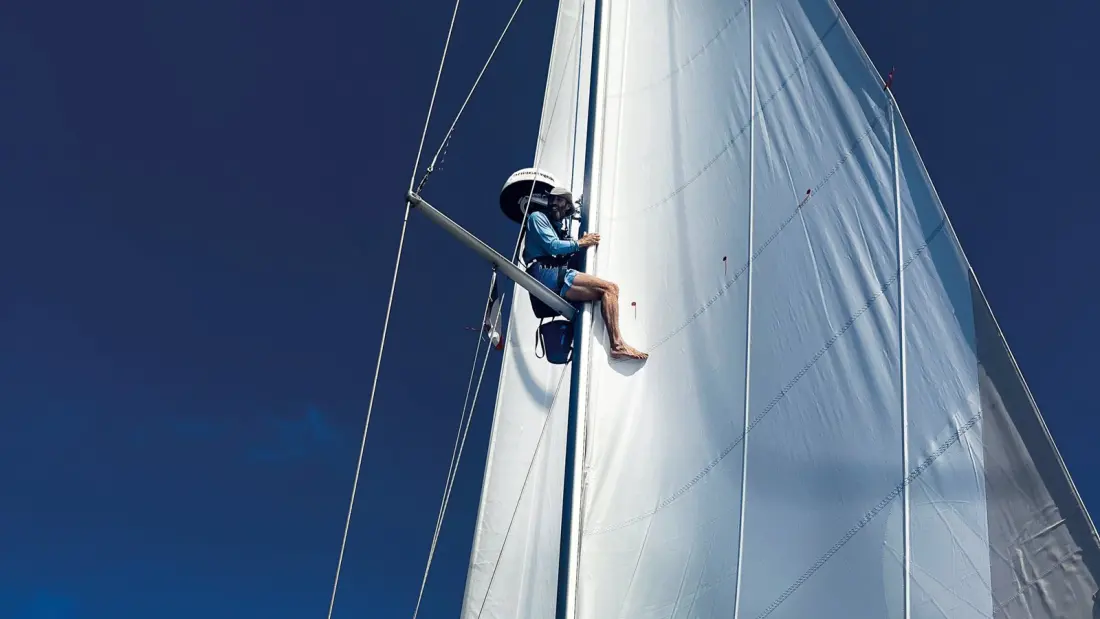
Then, on day six, came the real problem. Inspecting the rig after a small fix aloft, Ainsworth found three of 19 strands failed on the port D1 shroud, four on starboard. It unravelled from there: by day 26 the port D1 had to be cut away with an angle grinder; by day 32 both port shrouds were gone. Guided by riggers over WhatsApp (Starlink's offshore connection proved its worth), they built a jury rig from 12 lines and eight blocks, backstaying to stern cleats and tensioning with truckers' hitches and icicle hitches. Loads were so violent that Dyneema soft shackles exploded and metal ratchet-strap hooks bent to failure. On the sixth trip up the mast, with it flexing half a metre per roll, Ainsworth made the call that probably saved his life: no more climbing. Work from the deck only.
With the mast too compromised to carry canvas, they motored the final 1,300 miles — 274 engine hours on swells that let them sleep in 10-minute bursts. Mid-passage came a second crisis: the alternator regulator had been pushing 15-16V into the batteries for days, causing thermal runaway. The swollen bank cooled from over 70°C to 35°C while they sat ready to launch the liferaft, photos of their children already in the grab bag.
Salvation arrived twice. First, yachts 38 South and Ole Pinelle detoured to shepherd them for five days. Then, after JRCC Tahiti put out the call, a 245m cargo ship — whose master volunteered when two others declined — diverted 365 miles and transferred 14 jerry cans of diesel on long lines in rolling seas, holding station until every can was safely aboard.
On day 42 the Marquesas appeared at sunset, 35 miles out. They anchored at Hanamoena on Tahuata, eight miles from Hiva Oa, greeted by feeding manta rays and — improbably — a cruiser friend who'd left Panama the same day and arrived two weeks earlier. A rigger later repaired the rig; replacement batteries came by supply ship.
The takeaways for anyone dreaming of a Pacific crossing: carry fuel reserves for the worst, not the best; don't assume wind; have reliable offshore communications; and know that rigging fails gradually, then suddenly. Morale matters as much as seamanship — Ainsworth credits his partner's muffins, crêpes and full English breakfasts with keeping them sane.