Florence and Pisa get the crowds, but Tuscany's real magic is scattered across its countryside in a string of medieval hill towns, many of which you can have almost to yourself if you time it right. A new roundup of the region's best small towns and villages makes a strong case for skipping the big three entirely.
Start with the obvious star: San Gimignano, whose stone towers were built between the 11th and 13th centuries by noble families competing to flaunt their wealth. Around 72 once pierced the skyline; 14 survive today, and climbing between them, the cathedral and the civic museum on Piazza del Duomo fills a very happy day. For something different, stay at Agrivilla I Pini, a former pilgrim shelter turned vegan eco-farmhouse with 11 minimalist rooms from about £406.
Wine drinkers should head south to the Val d'Orcia. Montalcino produces the celebrated brunello and rosso reds, and Enoteca la Forrez lets you taste them inside the town's medieval fortress, cheese and cured meats included. Nearby Pienza is a walled Renaissance gem where streets named Via dell'Amore and Via del Bacio lead to Piazza Pio II, flanked by two former papal palaces now open as museums – one home to Pietro Lorenzetti's Madonna of Monticchiello. Relais Il Chiostro di Pienza, a converted Franciscan convent, has rooms from £113.
In Chianti country, Greve in Chianti centres on the triangular, portico-lined Piazza Matteotti, while tiny Montefioralle just below it is one of Tuscany's oldest villages, still wrapped in its original walls and nearly car-free.
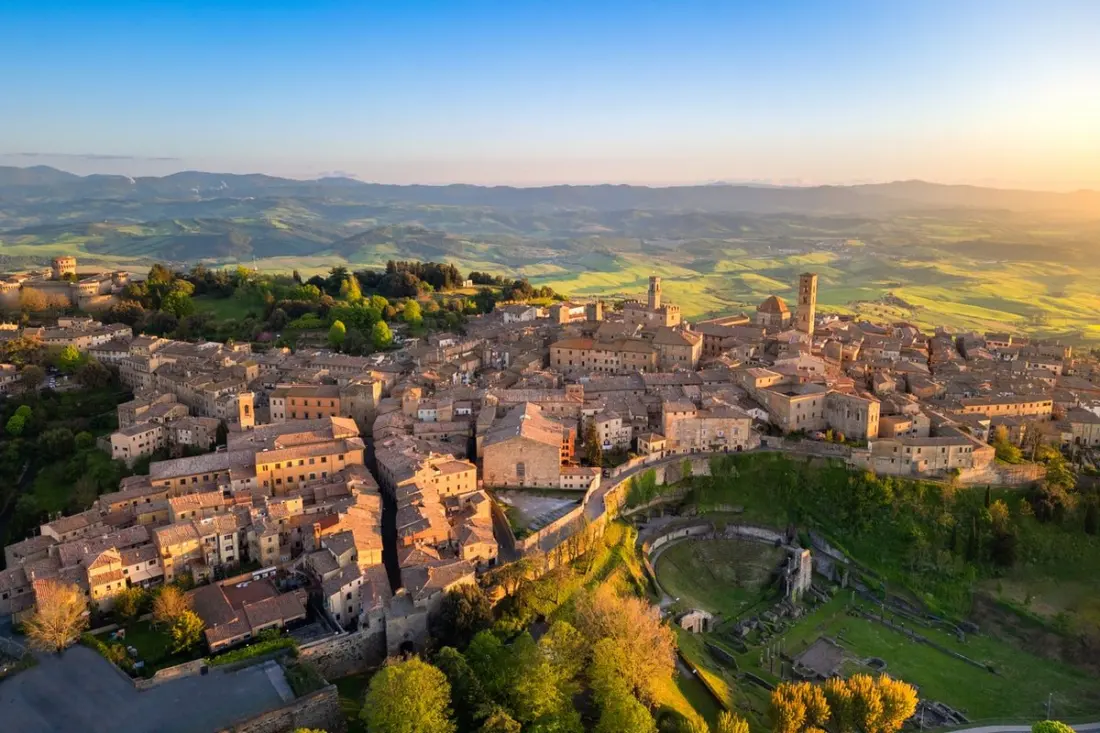
Volterra packs in the history: Etruscan walls and a museum with the famous bronze Ombra della Sera, a 2,000-year-old Roman amphitheatre, and a food scene heavy on truffles, pici pasta and unpasteurised Pecorino delle Balze Volterrane. Pitigliano, further south in the Maremma, is built dramatically on volcanic tuff rock and nicknamed "Little Jerusalem" for its historic Jewish quarter, complete with synagogue, museum and a kosher wine cellar carved underground.
Closer to the coast, Pietrasanta has one of Italy's densest concentrations of art galleries – Michelangelo once knocked around here – plus beaches and the upmarket resort town of Forte dei Marmi next door. And for the full wine-and-wellness combo, Montepulciano offers its Vino Nobile in cellars like the vaulted De' Ricci "Cathedral of Wine", plus sulphur-rich thermal baths.
Who's this for? Anyone planning a 2027 Tuscan trip beyond the guidebook hits. A car is the practical way to string several of these towns together, and each works as a base: budget stays like Hotel della Fortezza in Sorano (from £105) sit alongside wine-resort splurges like Borgo San Vincenzo near Montepulciano (from £568). Pick two or three towns, mix a hill town with a vineyard or the coast, and you'll see a side of Tuscany most day-trippers from Florence never do.
Story via The Independent Travel.