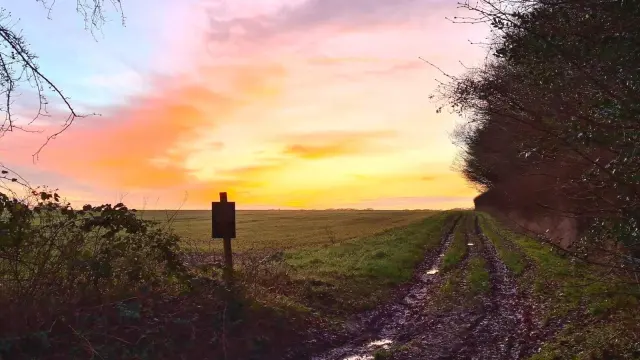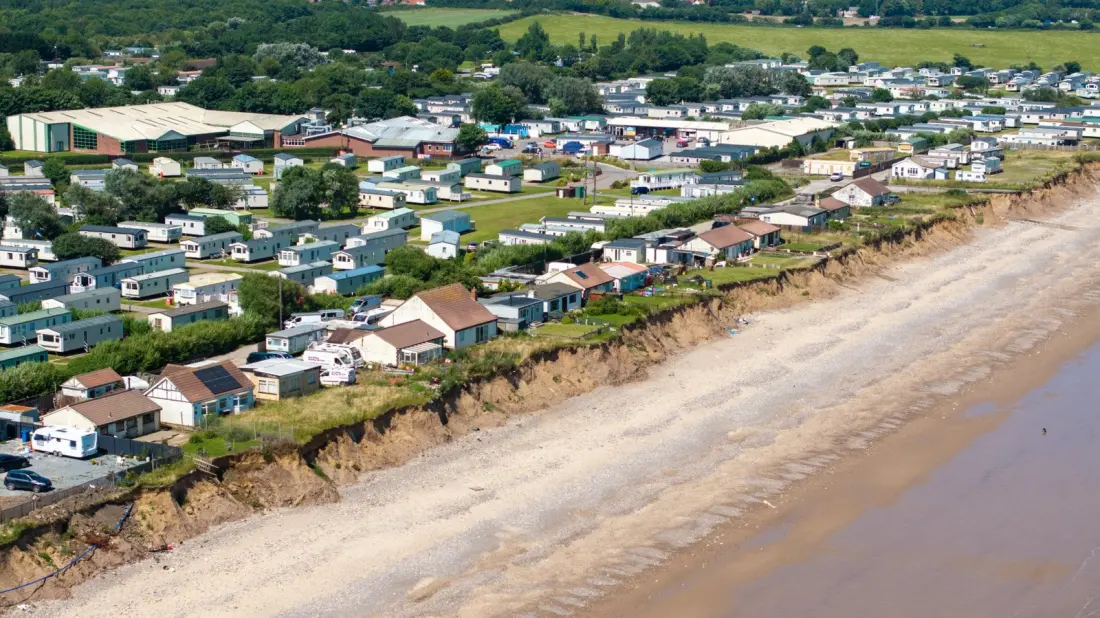
Fifteen minutes south of Bridlington — the East Yorkshire port that bills itself the "Lobster Capital of Europe" — sits Skipsea, a village of around 700 people on the Holderness Peninsula. It has a wide, empty beach, a thousand years of history and an unusual claim to fame: it sits on the fastest-eroding coastline in Europe, losing roughly seven feet of land to the North Sea every year. Villages have been disappearing along this stretch of coast since Roman times, and Skipsea is very much living on borrowed sand.
That fragility is part of the appeal for a certain kind of traveller. The beach here is isolated and undeveloped, with nothing but horizon ahead of you — though access can be tricky because of the ongoing erosion. If you want coastal quiet rather than promenades and amusement arcades, this is the vibe.
Camping is the obvious way to stay. Mill Farm Country Park is a well-reviewed rural option: a roomy field ringed by tall hedges, with showers, electric hookups, dogs welcome, and pitches for everything from small tents to motorhomes, about a 15-minute walk from the sea. Mr. Moo's Touring Park splits its ground into an adults-only area and a family area, divided by woodland, with a footpath to the beach past grazing Saler cattle — plus an attached ice-cream parlour. Grass pitches run May to October, hardstanding from March to November, and reviewers praise its spotless facilities. Strawberry Fields Holiday Park is the closest to the sand, roughly 2,400 feet away, with picnic tables, showers and recently renovated bathrooms.
The history fix comes via Skipsea Castle, a free-to-visit motte-and-bailey earthwork on Beeford Road, an easy 20-minute stroll from the village. The site mattered long before 1066 — the mound itself has been dated to the Iron Age — and after the Norman Conquest it became the stronghold of the lords of Holderness under William the Conqueror. King Henry III ordered it destroyed in 1221, and by the 1300s it was being used as pasture. Today you'll find the conical mound, defensive banks and ramparts standing in an open rough field, livestock wandering through, and an information plaque explaining the backstory. Bring sensible footwear and don't expect visitor facilities.
Skipsea works for campers, walkers and anyone chasing a low-key escape with real history attached — best paired with Bridlington up the road and Hull, named by National Geographic among its best cities to visit in 2026, half an hour west. It's worth seeing sooner rather than later: the sea isn't waiting around.
Story via Islands.