
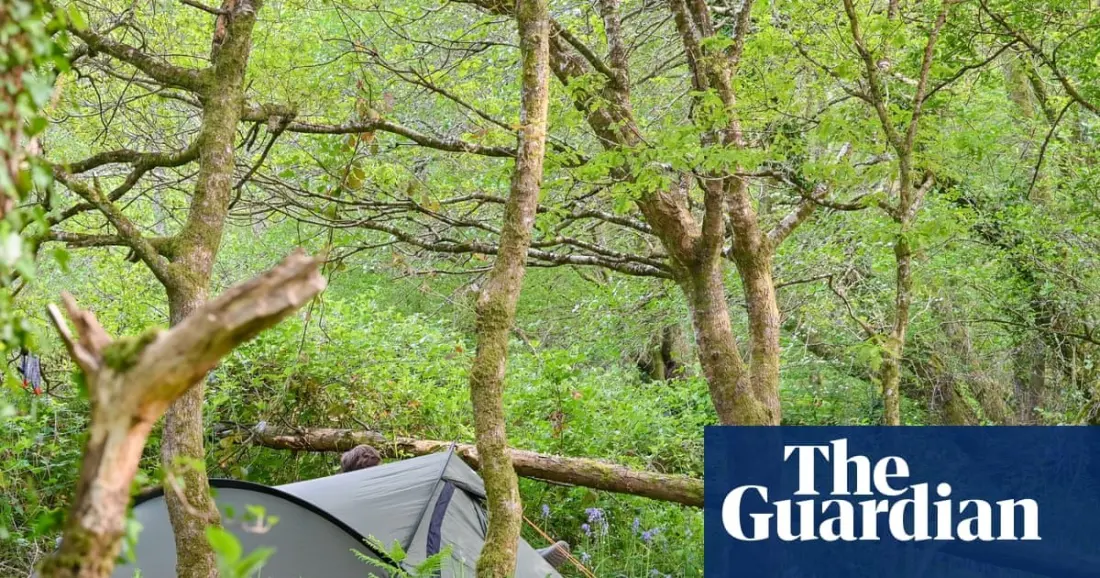
Tent pitches next to one of Britain's rarest habitats are hard to come by, but a small campsite on Dartmoor's eastern edge now offers exactly that. Wray Valley Camping, between the villages of Lustleigh and Moretonhampstead in Devon, sits beside a fragment of temperate rainforest — the damp, mossy Atlantic woodland that once covered a fifth of the UK and has since lost more than 95% of its extent.
The site is the work of Michelle Grist, a retired environmental consultant, and her partner Kevin Chamberlain, who spent seven years building the campsite from scratch while coaxing the woodland back to life. That meant draining flooded land, planting 1,200 native plants and 45 saplings, laying 200 metres of hedgerow and ripping out invasive species. In February this year, six acres of their 10-acre estate were designated a Devon county wildlife site, formally recognising the habitat's importance.
The camping style is deliberately low-impact. There are six pitches in the Hay Meadow plus four "Nearly Wild" pitches aimed at people who want something closer to proper wild camping — but with a hot shower. No electric hookups, and cars stay in the car park: you wheelbarrow your gear to your pitch. The site is carbon-negative, running on borehole water and solar power, with discounts for anyone arriving on foot, by bike or by public transport. Prices are modest: £10 per adult and £8 per child per night on small pitches, or large pitches from £40 for four people, showers and toilets included.
The setting rewards a slower pace. A signposted sustainability trail loops the woodland, where pied flycatchers flit between oaks, hazels and rowans, stonechats call from the shrubs and oil beetles cross the mossy stones. Running alongside is the Wray Valley Trail, an 11km walking and cycling route on the trackbed of a former steam railway that once hauled timber and stone through the valley. It links Moretonhampstead, Lustleigh and Bovey Tracey, and makes a handy low-traffic spine for a few days of exploring — pedal to Lustleigh, then on towards Hound Tor, where granite boulders tower over the remains of abandoned medieval settlements.
One nearby sight worth a caveat: Wistman's Wood, Dartmoor's most famous rainforest, is about 40 minutes away by car, but its popularity has taken a toll, with eroded paths and trampled mosses. Wray Valley's owners are betting on the opposite model — few visitors, minimal infrastructure, and guests willing to put in a bit of effort. So far it seems to be self-selecting the right crowd; recent guests have included a horticulturist cataloguing the site's plants and scout groups joining woodland management days.
For anyone who has ever wanted to camp somewhere genuinely rare — and hear every owl hoot and bat wingbeat once the light fades — this is a thoughtful, affordable way to do it.