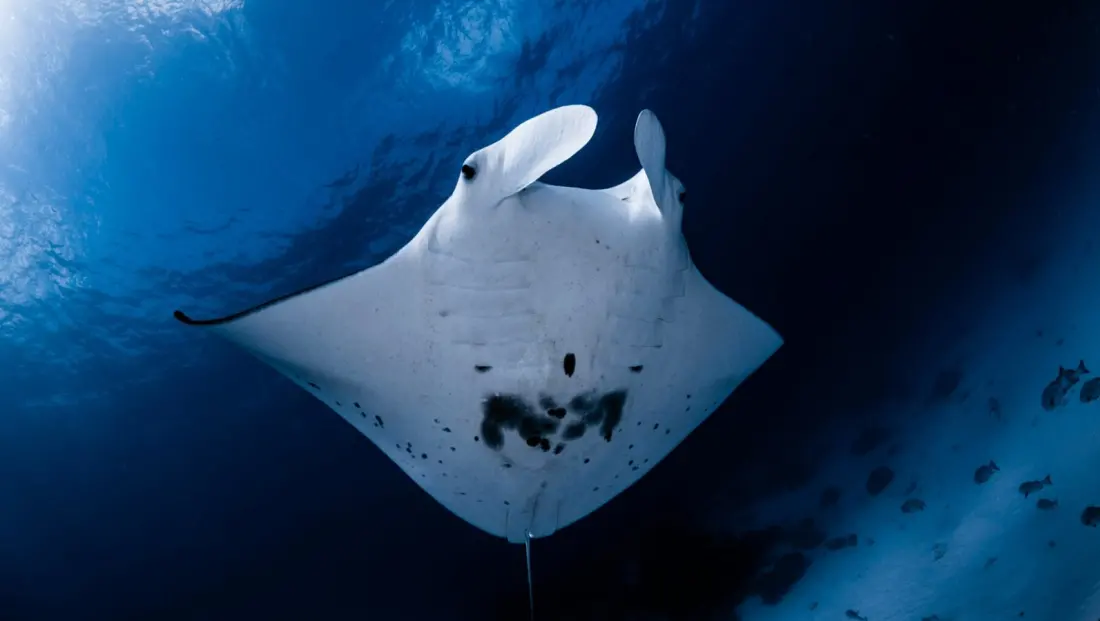
Manta rays move like birds gliding underwater, banking through the ocean on wings that can span several metres. They're also among the least understood large animals on Earth — and Australia's Lady Elliot Island, at the southern tip of the Great Barrier Reef, is one of the best places on the planet to see them.
Until 2008, scientists believed there was just one manta species worldwide. Then biologist Andrea Marshall spotted two distinct types swimming together, and the field opened up. Three species are now recognised — reef manta, giant oceanic manta and the Atlantic manta, formally described only in 2025. Australia hosts the first two. The reason for the slow science is simple: mantas never surface to breathe, never come ashore and roam deep oceanic waters, so tracking them is genuinely hard. Scientists still don't know where reef mantas raise their young.
Lady Elliot Island is one of the country's key manta aggregation sites. Reef mantas gather there in peak numbers during winter, when nutrient-rich upwellings fuel blooms of zooplankton — the tiny food these giants sieve through specially adapted gill plates, much like whale sharks. Researchers once counted nearly 80 mantas feeding around the island in a single day. The reefs also serve as cleaning stations, where mantas hover above coral bommies while small wrasse pick parasites from their skin.
Their biology makes them fragile. A female may not breed until she's ten, carries a single pup for over a year, and might wait up to eight years between pregnancies. That slow pace, combined with hunting for gill plates used in traditional medicine — with local declines of up to 90 per cent in some regions — plus boat strikes and entanglement in marine debris, has hit populations hard. Warming oceans that shift plankton distribution add another layer of risk. Australia's comparatively healthy manta populations offer scientists a rare benchmark of what thriving mantas look like.
The twist is that holidaymakers are central to the research. Every manta's spotted belly pattern is unique, like a fingerprint, so any snorkeller or diver with a camera can contribute. Thousands of photos submitted through Project Manta, run by the University of the Sunshine Coast, have helped track individuals across hundreds of kilometres, map seasonal migrations along the east coast and identify the reefs that matter most. Add acoustic tags and satellite tracking, and researchers hope to solve remaining mysteries — including where the Whitsundays' mantas vanish each summer.
For travellers, this turns a snorkel trip into something more meaningful. Swim with a manta at Lady Elliot, photograph its underside, and you may directly contribute to its life story — and to the case for protecting a species that barely registers on science's radar.