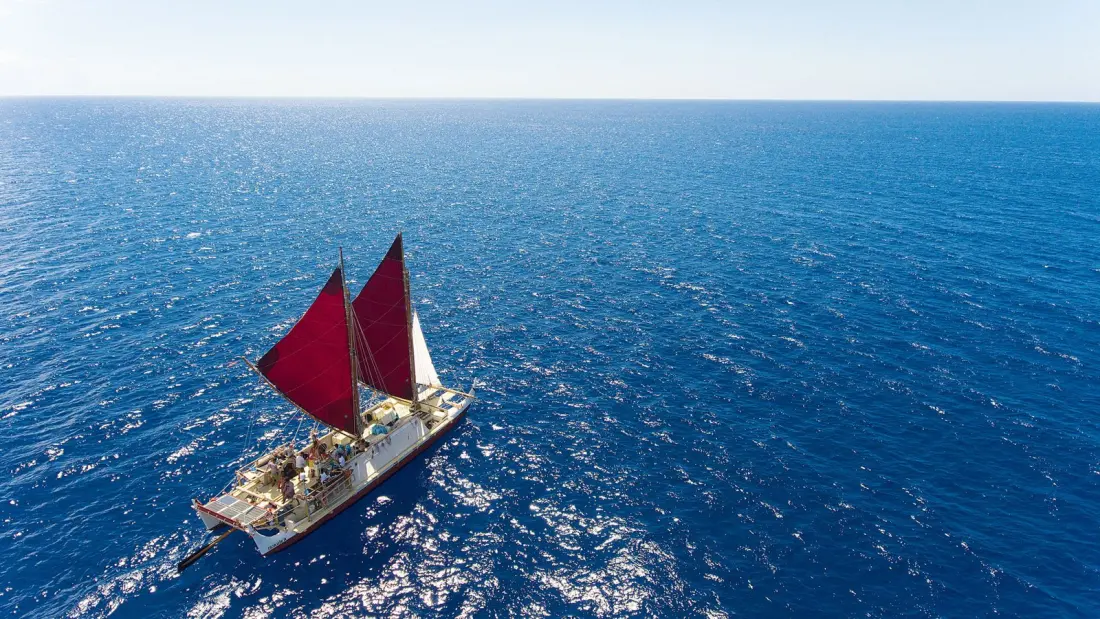
In November 2025, a crew of ten Hawaiian sailors sailed from the Cook Islands to New Zealand's Bay of Islands — roughly 1,600 miles of open ocean — with no engine, no GPS, no autopilot, no charts and not even a compass. Their vessel was Hōkūle'a, a replica of a traditional double-hulled Polynesian voyaging canoe, and their only instruments were nature itself: rising and setting stars, the direction of swells, the flight paths of birds, the shape and colour of clouds. After 15 days of cold southern swells and fickle winds, they made landfall.
The voyage is one leg of the Moananuiākea Voyage, a 43,000-mile, six-year circumnavigation of the Pacific that launched from Juneau, Alaska in June 2023. Hōkūle'a, built by the Polynesian Voyaging Society, has now logged more than 280,000 instrument-free miles over five decades, starting with the landmark 1976 sail from Hawaii to Tahiti. That crossing helped overturn a long-held western assumption that Pacific islands were settled by accident rather than deliberate, skilled navigation.
The knowledge nearly died out in Hawaii — master navigator Nainoa Thompson, the first native Hawaiian in over 600 years to practise traditional wayfinding, learned from Mau Piailug, a palu (master navigator) from Satawal in Micronesia who never lost the art. Thompson reckons a navigator makes around 5,000 observations a day and 500 choices on trim, course and steering. Captain and navigator Lehua Kamalu, who led the New Zealand crossing, is expected to become one of the first women in recorded history to receive pwo, master navigator status.
The crossing wasn't romanticised: the crew endured cold, wet weather on an open canoe with no cabin, stars often hidden by cloud, and a hull that, in Kamalu's words, you negotiate with rather than command. Rewards came near New Zealand's North Island — whales, albatrosses and dolphins escorting the canoe in. The landfall also marked 40 years since Hōkūle'a's first arrival in 1985, which sparked a Māori canoe-building renaissance led by master carver Sir Hector Busby.
After refitting in Auckland, Hōkūle'a and her sister canoe Hikianalia will continue north through Tonga, Samoa and Fiji, then to the Marshall Islands, the Philippines and Micronesia, reaching Taiwan and Japan in 2027 before returning via Rapa Nui and the Marquesas in 2028. About a third of the current crew are in their twenties, and Hawaiian schoolchildren now learn wayfinding basics — a living tradition, not a museum piece.
For travellers, this is a rare chance to witness genuine living maritime culture. Ports along the route — Auckland, Nuku'alofa, Apia, Suva — may see the canoes arrive, often with public welcomes and educational events. Even if you never set foot on a sailing canoe, understanding wayfinding adds real depth to any Pacific trip: it explains how humans deliberately settled the world's largest ocean long before Europe's Age of Sail.