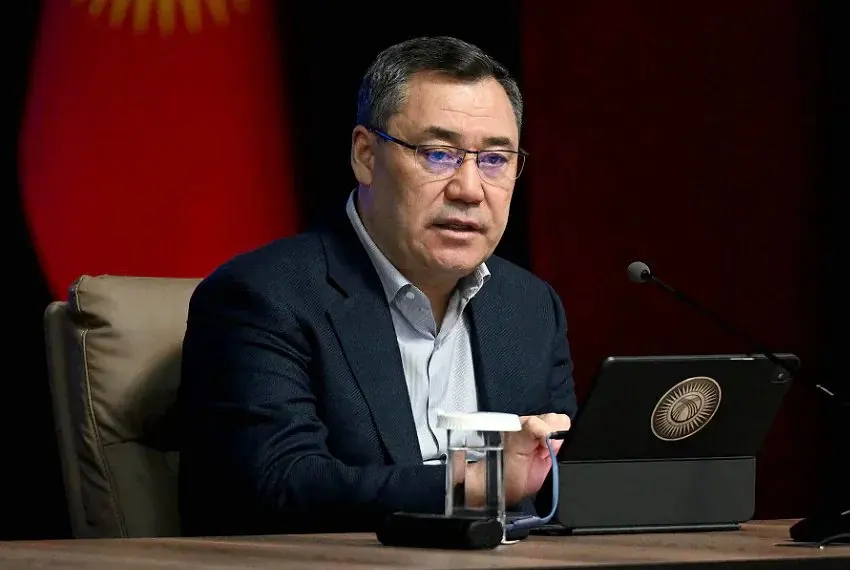
Talas, the small regional capital in northwestern Kyrgyzstan that most travellers only pass through en route to the mountains, is in the middle of a serious transformation. President Sadyr Japarov was briefed on the city's development during a working visit, and the numbers are striking: the municipal budget has grown from 224 million soms in 2021 to a projected 947.6 million soms for 2026 — more than a fourfold increase. Investment has surged even faster, from 515.6 million soms to an expected 8.2 billion, roughly sixteen times more.
Where has the money gone? Projects worth 11.8 billion soms have landed in the city over five years. New additions include Talas Arena stadium, the Baatyrlar Central Park, a renovated central square, the K. Nurzhanov Alley, a children's entertainment centre called Balastan, and new education facilities — a branch of Jusup Balasagyn Kyrgyz National University and the Akylman Presidential Lyceum. Getting around has improved too: thirty modern Yutong electric buses now run in the city, part of a wider push to clean up public transport.
Roads and public spaces have seen the biggest spend. Around 2.08 billion soms from the national budget went into road infrastructure between 2021 and 2026, resulting in 57.6 kilometres of freshly paved roads and 62 kilometres of new sidewalks. On the social side, 35 facilities got major renovations and five new ones were built. Industrial output has doubled over the period, from 1.3 billion to a projected 3 billion soms.
There's more to come. The next round of work — worth around 1.1 billion soms — includes paving another 12 kilometres of roads, reconstructing the bus station, building a modern municipal bus fleet, and expanding drinking water and sewage systems. Keep in mind that the 2026 figures are projections, since the year's final numbers haven't been tallied yet.
For travellers, why does this matter? Talas has long been a rough-edged waypoint between Bishkek and western Kyrgyzstan, better known as the legendary birthplace of the epic hero Manas than as a place to linger. A revamped central square, a proper stadium, new parks and electric buses suggest a city that's becoming more pleasant to actually spend time in — handy if you're heading to nearby Manas-Ordo or using Talas as a base for trekking in the Talas Alatau range. A rebuilt bus station, if delivered, will also make overland connections smoother. The region remains far off the main tourist circuit compared with Issyk-Kul or Karakol, which is precisely its appeal: authentic, affordable and now noticeably easier on the eyes.