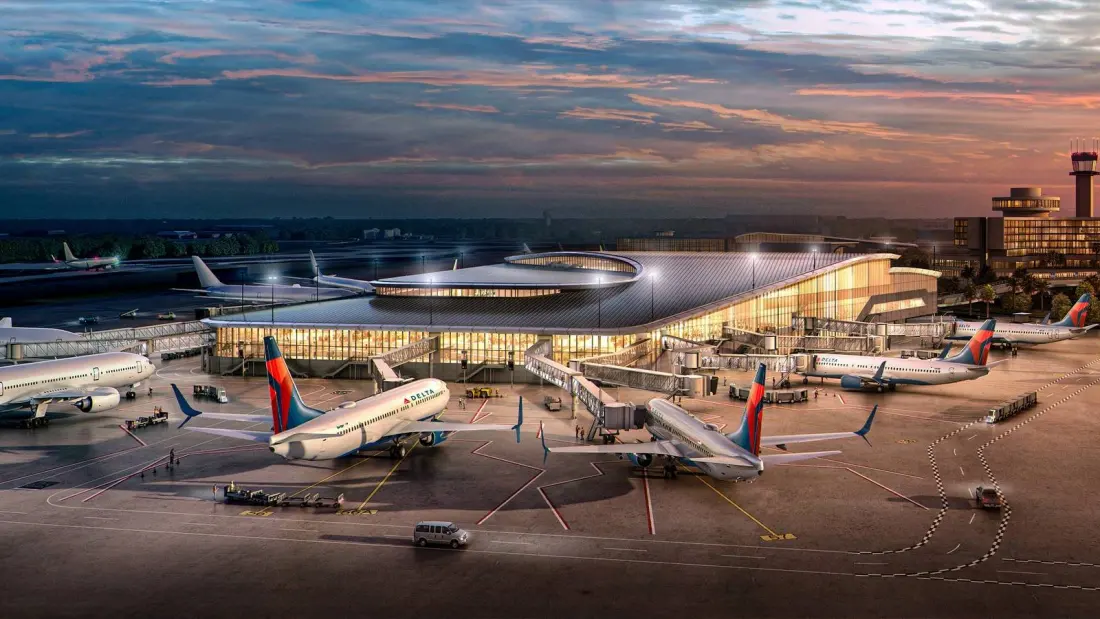
Tampa International Airport is spending $1.528 billion on its first new airside terminal in nearly two decades, and Delta Air Lines has just signed the kind of deal that suggests big things are coming. The airline has committed to a 20-year anchor lease covering at least six of the 16 gates in the new Airside D facility, complete with a purpose-built Delta Sky Club — its first at TPA.
The terminal is a serious piece of infrastructure: 600,000 square feet, an eight-lane security checkpoint, and — crucially — a dedicated Federal Inspection Services area for processing international arrivals. Steel erection is already underway, with a 300-ton crane assembling 6,200 tons of steel across more than 7,300 pieces. Construction wraps in late 2028, with a public opening in 2029. Once running, Airside D lifts the airport's annual passenger capacity from 25 million to 35 million by 2037. That matters because TPA handled 24.5 million passengers in fiscal 2025 and is bumping against its ceiling.
The international angle is the interesting part. Tampa already has some overseas service — Delta flies year-round to Amsterdam on an A330-900neo, Edelweiss covers Zurich, and avianca recently started daily Bogota flights. What the airport lacks is the customs processing capacity to grow that meaningfully. The new FIS facility changes the equation, letting widebody international arrivals be handled alongside domestic operations on the same concourse. That makes routes to London or Paris operationally realistic for the first time.
There's a telling statistic behind all this: roughly half of Tampa Bay's international travellers currently drive to Miami, Orlando or Fort Lauderdale to fly abroad, because nonstop options from their home airport are so thin. Airside D is designed to win those passengers back — and the local market is there to support it. The four-county metro area has grown by over 400,000 people since 2010 and now tops 3.3 million, with finance, healthcare and tech adding corporate travel demand on top of the usual tourism.
To be clear, this doesn't make Tampa a Delta hub on the scale of Atlanta or Detroit. It's a long-term focus city — Delta runs about 45 daily departures to cities including New York-JFK, Boston, Salt Lake City and Minneapolis. But a two-decade lease plus a premium lounge signals a level of investment Delta usually reserves for places it plans to grow for decades. Timing helps too: Delta's first A350-1000 deliveries start in late 2026, which could free up A330-900neos and A350-900s for new routes from secondary cities like Tampa.
For travellers, the takeaway is simple: from 2029, flying to Europe directly from Florida's Gulf Coast gets a lot more plausible — and Tampa's airport becomes a genuinely convenient alternative to the Miami-Orlando slog down the interstate.