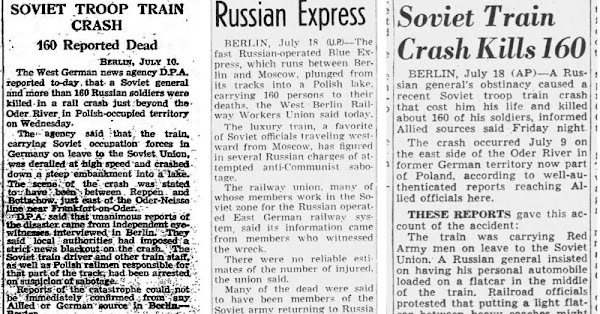
Somewhere between the small Polish town of Rzepin and the village of Boczów, on 9 July 1952, a Soviet military train supposedly derailed, plunged into a lake and killed around 160 Red Army soldiers heading home from Germany. The catch? Nobody has ever proven the crash happened at all.
The story broke in Western newspapers in mid-July 1952, picked up by the Associated Press and United Press from unnamed Allied sources. The doomed train allegedly ran on the famous Blue Express route, the service linking Berlin and Moscow that carried Soviet troops and officials between the occupation zone in Germany and the USSR. One version blamed a Soviet general who insisted on loading his car onto a flatcar in the middle of the train; the lopsided weight supposedly buckled the train on a curve. Other reports pointed to anti-communist Polish partisans sabotaging the rails. Canadian diplomat Robert A.D. Ford, passing through shortly afterwards, noted unusually heavy military and police activity. And the CIA observed that from 20 July 1952 the Blue Express was rerouted through Czechoslovakia, which hinted that the authorities themselves feared sabotage in Poland.
What makes the case genuinely intriguing is the silence from the other side. No Polish or Soviet confirmation of the disaster has ever surfaced, and no official documentation survives. That fits the era: Stalinist Poland and the USSR routinely buried bad news, especially anything involving the military. Some concealed disasters later proved very real — the Kyshtym nuclear accident and the Nedelin rocket explosion both stayed hidden for years. So Western journalists found the rumours credible, even without a shred of official acknowledgement.
Stranger still, Rzepin was not alone. In October 1949, reports claimed a train crash in Nowy Dwór Mazowiecki, north of Warsaw, killed around 200 people. Same pattern: large death toll, wide Western coverage, and total silence from Polish authorities then and since. A military train crash is arguably the more concealable of the two — a civilian disaster killing local families would have left hundreds of witnesses — yet neither has ever been confirmed.
For travellers passing through western Poland today, Rzepin is just a quiet stop on the Berlin–Warsaw rail corridor, close to the German border and within easy reach of Zielona Góra and Frankfurt an der Oder. Nothing marks the site of the alleged crash. But if you ride that line, you're tracing the old Blue Express route itself — and a story that shows how, behind the Iron Curtain, even a major rail disaster could vanish from the record. It's less a destination than a reason to look at an ordinary train window with a little more curiosity.