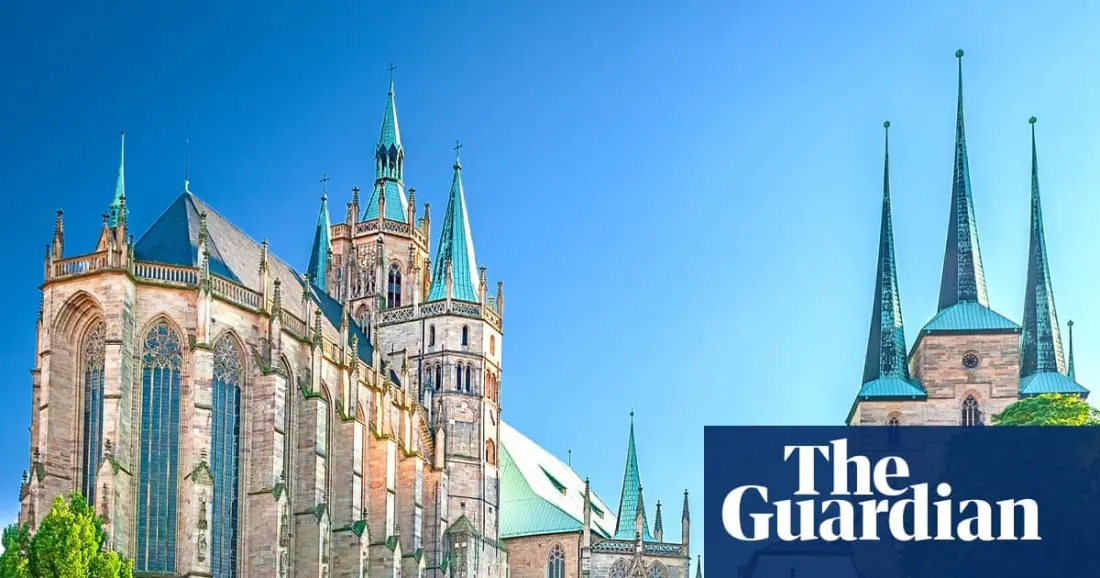
Erfurt makes a striking first impression. On Domplatz, market traders unpack crates of flowers and vegetables beneath towers of a 14th- and 15th-century cathedral that holds the Gloriosa, the world's largest medieval free-swinging bell — cast in 1497 and weighing 12 tonnes. This is the capital of Thuringia, the forested state in central Germany often called the country's "green heart", and it turns out to be perfectly doable without a car.
The compact old town packs in a 120-metre medieval bridge, the Krämerbrücke, lined with half-timbered craft shops — some still selling the blue dye from woad, the crop that once made the city rich. Petersberg Citadel, among Europe's largest surviving fortresses, hides a maze of tunnels, and the city has Reformation pedigree too: Martin Luther studied here and lived as a monk in the Augustinian monastery, which offers tours and even overnight stays. For dinner, Wirtshaus Christoffel serves beef roulade with Thuringian dumplings in a building dating to the 12th century.
Culture ticks come thick and fast. Egapark, a short bus ride away, spreads 36 hectares of gardens across the grounds of the old Cyriaksburg fortress, with a German Horticultural Museum tucked inside. Thirty minutes by bus sits Weimar — birthplace of the Bauhaus, home to a first-rate Bauhaus museum and the university that grew out of its original art school, plus the town where Germany's first democratic constitution was signed.
Then the pace changes. Bad Langensalza, a spa town an hour or so away, has sulphur springs discovered in 1811, ten parks and themed gardens, and the Friederiken Therme with thermal pools and saunas. Its Japanese garden, Kofuku no Niwa, is a quietly lovely detour, complete with koi ponds and sculpted pines.
Ten minutes further lies Hainich national park, part of a Unesco world heritage site and Germany's largest unbroken stretch of deciduous woodland: 7,500 hectares of beech forest with more than 75 miles of signposted trails, where deadwood is deliberately left to rot for rare insects and Bechstein's bats. The Baumkronenpfad treetop walkway climbs to a 44-metre tower that puts you level with the canopy of a 350-year-old oak. Fuel up first at the Forsthaus Thiemsburg restaurant — roast pork in black beer with dumplings, ideally with a Köstritzer pilsner.
Back in Erfurt, summer evenings end with open-air symphony concerts at Theaterplatz. Over four days, the whole loop — cities, spas and deep forest — runs on short bus rides, with the VMT app handling timetables and live departures. The writer stayed at the Dorint Hotel am Dom, doubles from £85.
For anyone who's ticked off Berlin and Munich, Thuringia offers a less obvious German break: big-name history, proper spa time and genuinely wild woodland, all reachable on regional transport from Frankfurt, about three hours away by coach.