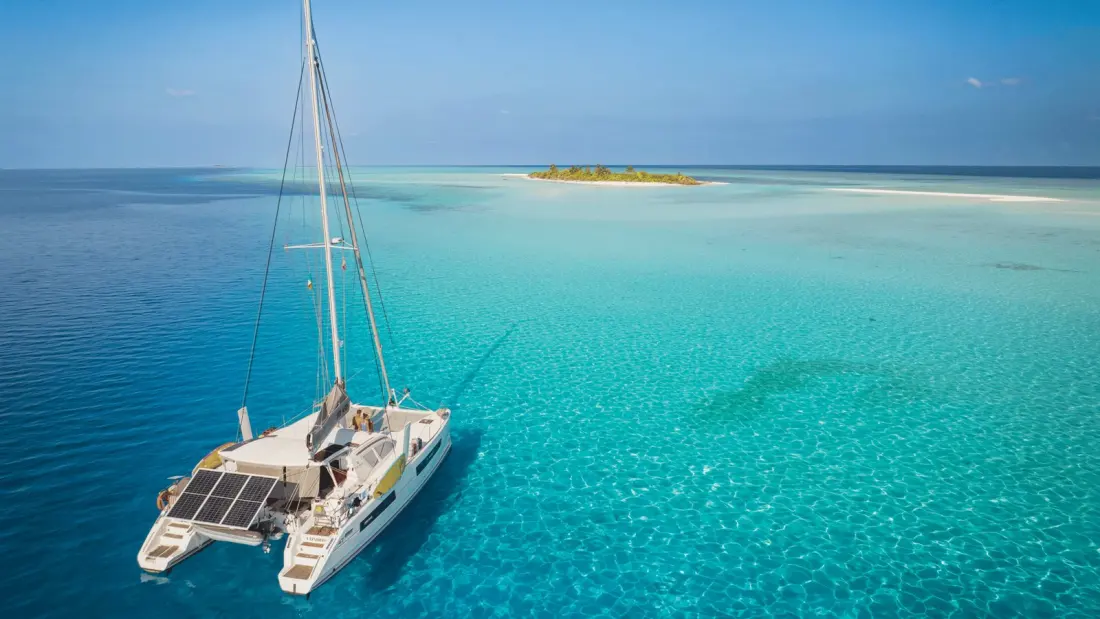
After 18 months cruising south-east Asia, one sailing couple pointed their Catana 47, Polaris, west from Phuket and set off on a 1,500-mile passage to the Maldives — the first leg of an Indian Ocean route that would eventually take them 6,000 nautical miles and two hemispheres, all the way to South Africa via the remote Chagos archipelago.
The Indian Ocean doesn't do simple. Unlike the Pacific or Atlantic, there's no easy downwind crossing: everything hinges on the monsoon cycle, trade winds and cyclone seasons. The westbound window in the northern hemisphere opens with the north-east monsoon from November to April, with January and February the sweet spot. Their plan was to cross the equator in late April — after that, thunderstorms and westerlies make many Maldivian anchorages untenable — then push 300 miles south to Chagos for a month, before riding the south-east trades to the Seychelles.
The passage itself was a slog: ten-mile rain squalls and lightning near Sumatra, a punishing current battle off Great Nicobar, and chaotic 3-4m seas funnelling down from India past the southern tip of Sri Lanka. Nine and a half days later, they reached Uligan in the Maldives' northernmost atoll, greeted by spinner dolphins and stingrays in the anchorage.
What followed was a Maldives most visitors never see. A 90-day cruising visa let them sail the whole 500-mile string of 26 atolls independently — though mandatory agent, anchoring and vessel-tracking fees make it one of the priciest cruising grounds going. Highlights included freediving coral walls in glassy 20m-plus visibility, kiteboarding the sandbars of Kagimar lagoon, and a troupe of 15 manta rays circling their boat for hours near Kelaa. Not everything was postcard-perfect: around the busy central atolls near Malé, they found reefs bleached white or smothered in sediment, part of a wider loss that has cut coral cover by some 80% in places, alongside damage from reef channels bulldozed for resorts and up to 100 abandoned resort islands crumbling into the sea.
The final act took them to Chagos — one of the least visited archipelagos on earth, ringed by one of the planet's largest marine reserves, with seabird colonies and some of the healthiest reefs in the world. Access is by permit only, granted case by case with strict rules and hefty fees; roughly 19 boats were expected to visit all year. Permits allow up to 28 days, which meant about five weeks without seeing civilisation.
For anyone dreaming of a sailing trip through this corner of the Indian Ocean, the takeaway is timing and realism: go between November and April, expect a genuinely demanding offshore passage past Sri Lanka, budget generously for Maldivian cruising bureaucracy, and apply early if Chagos is on the list. The rewards — dolphins, mantas, empty lagoons — clearly justify the effort.