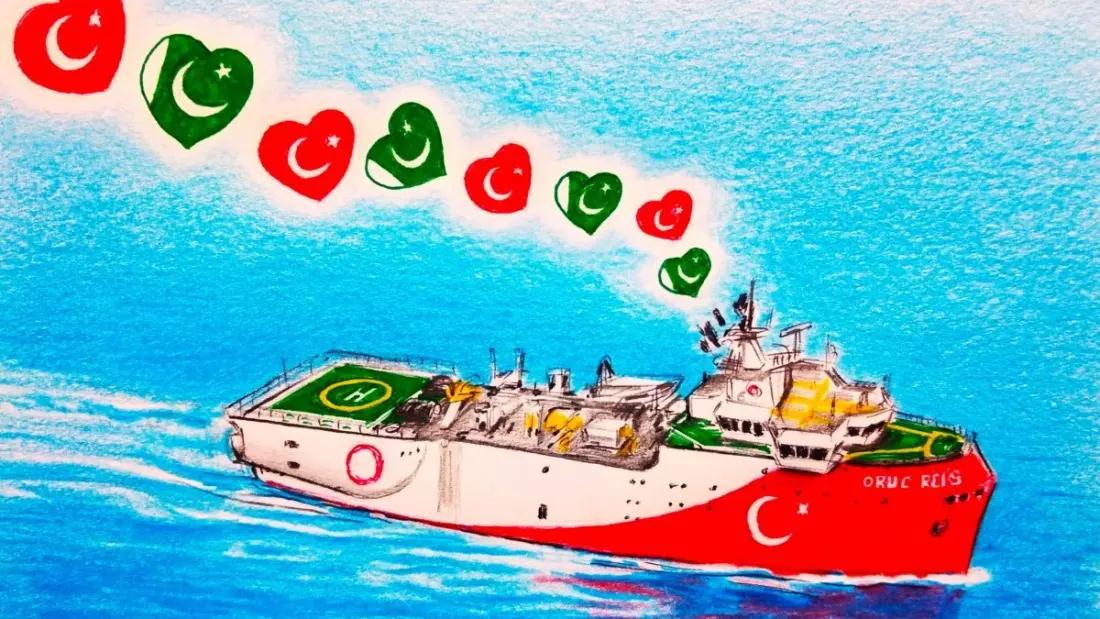
A Turkish seismic vessel called Oruç Reis arrived in Karachi on 19 November, marking a new phase in the relationship between Pakistan and Türkiye. The ship's mission: run two marine seismic surveys off Pakistan's coast to map what lies beneath the seabed, in the hope of locating oil and gas deposits that could cut the country's heavy reliance on imported fuel.
Two surveys are planned. The Marjan 3D survey in the Indus-C block is expected to take around 50 days, while the Makran 2D survey should run roughly 25 days. Seismic work involves sending sound waves into the earth to build images of subsurface geology — it can point to where hydrocarbons might exist, but doesn't confirm whether commercially usable quantities are actually there. Both governments are aiming to begin exploratory drilling in 2027, after the data has been analysed.
The economics explain the urgency. Between July 2025 and March 2026 alone, Pakistan imported about 13.9 million tonnes of crude oil and petroleum products at a cost of roughly $8.9 billion. Local production, if the surveys pay off, would ease pressure on foreign exchange reserves and shield transport, agriculture and manufacturing from global price swings and supply disruptions.
What makes the timing notable is how little offshore exploration Pakistan has actually seen. Only 18 wells have been drilled in its offshore zone since independence in 1947, and exploration only restarted in 2025 after an 18-year pause. Of 40 offshore blocks offered up, 23 drew interest. Turkish Petroleum Corporation is working with Pakistan's Oil and Gas Development Company, Pakistan Petroleum Limited and Mari Energies. The Karachi visit also produced agreements on mineral exploration, including antimony in Balochistan, plus plans to share geological data.
For Türkiye, the deployment extends a playbook it has already used elsewhere: the Oruç Reis carried out extensive survey work off Somalia, which led to Türkiye's first deep-water drilling project outside its own waters.
Whether any of this yields a producing field is far from guaranteed — exploration is expensive and slow, and success depends on geology and future investment. But the story matters as a signal of where Türkiye-Pakistan ties are heading: away from a purely defense-and-diplomacy relationship and towards hard economic projects in energy, mining and technology. For readers, it's a useful marker of how the Arabian Sea margin off Karachi and the Makran coast could become an active exploration frontier over the next few years, with all the geopolitical and investment implications that follow. — Daily Sabah Travel