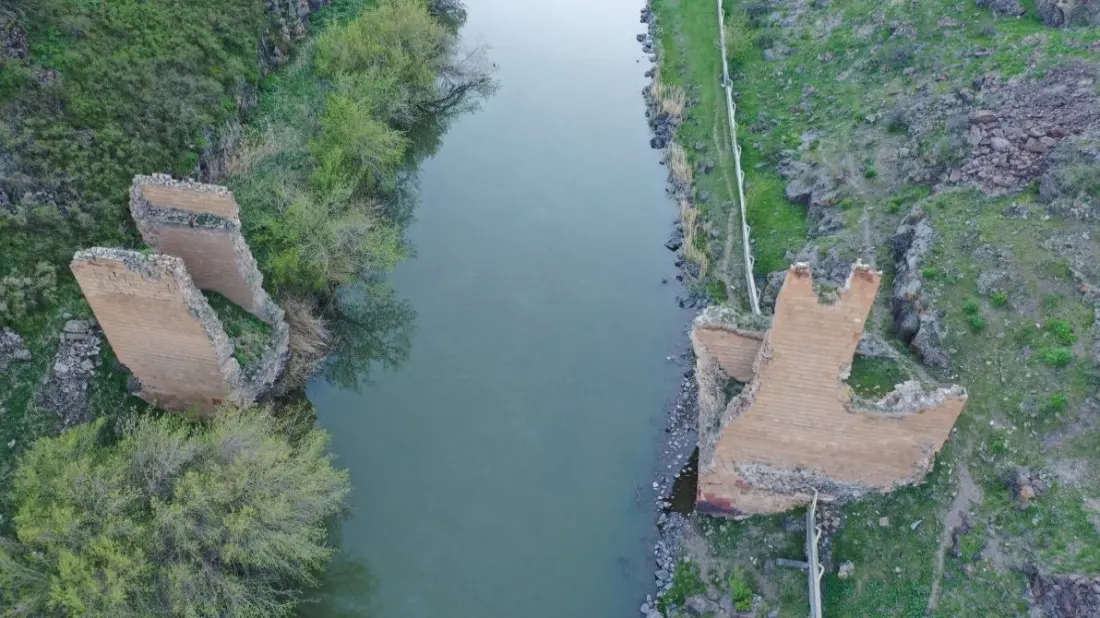
A 10th-century bridge that once carried Silk Road traders across the Arpaçay River is one step closer to standing again. Türkiye has completed the tender process for the reconstruction of the Ani Bridge, on the closed border with Armenia, and the work will be carried out jointly by the two countries.
Transport and Infrastructure Minister Abdulkadir Uraloğlu confirmed that the tender was held on 16 September and the contract signed on 28 September, wrapping up the procurement stage of a project that has become a symbol of the slow-moving normalisation between Ankara and Yerevan. The two sides signed a protocol in Yerevan on 4 May, at a meeting attended by Turkish Vice President Cevdet Yılmaz, setting out how the restoration will be handled. A joint commission — including Türkiye's Transport Ministry and the General Directorate of Highways (KGM) — will coordinate the work.
The original bridge was built in the 10th century as a customs checkpoint on the Silk Road, at the narrowest point of the Arpaçay, where the riverbed squeezes down to 36 metres. It stretched 80 metres long and 8 metres wide, with a circular arch spanning 31 metres. That arch collapsed on 16 October 1807, and today only the stone piers remain. Once restored, the crossing will again mark what was for centuries one of the key east–west trade links of the medieval world.
The bridge sits within the Ani archaeological site in Türkiye's eastern Kars province, a former Silk Road hub that UNESCO inscribed on the World Heritage List in 2016 with 21 cultural assets. Ani is one of the great forgotten cities of the Middle Ages — a walled settlement of churches, caravanserais and city gates that rivals anything in better-known Anatolian sites, yet sees a fraction of the visitors.
For travellers, the significance is twofold. Practically, a rebuilt bridge adds another reason to make the long trip to Kars, already popular for its evocative ruins, the nearby ruined city's winter atmosphere and Ani's dramatic position on a plateau above the river gorge. Symbolically, the joint Türkiye–Armenia project is the most concrete sign yet of a thaw between two neighbours whose border has been shut since 1993. If normalisation continues, it could eventually reopen a crossing point that would let travellers pass between the two countries — until now impossible — and link Kars directly to Armenia's own medieval heritage sites on the other side of the river.
No reopening date has been announced, and the restoration is a heritage project rather than a border opening, so don't book cross-border plans just yet. But Kars is well worth a visit regardless, and the sight of conservation teams rebuilding a Silk Road arch adds a live layer of history to an already remarkable site.
Full story: Daily Sabah Travel.