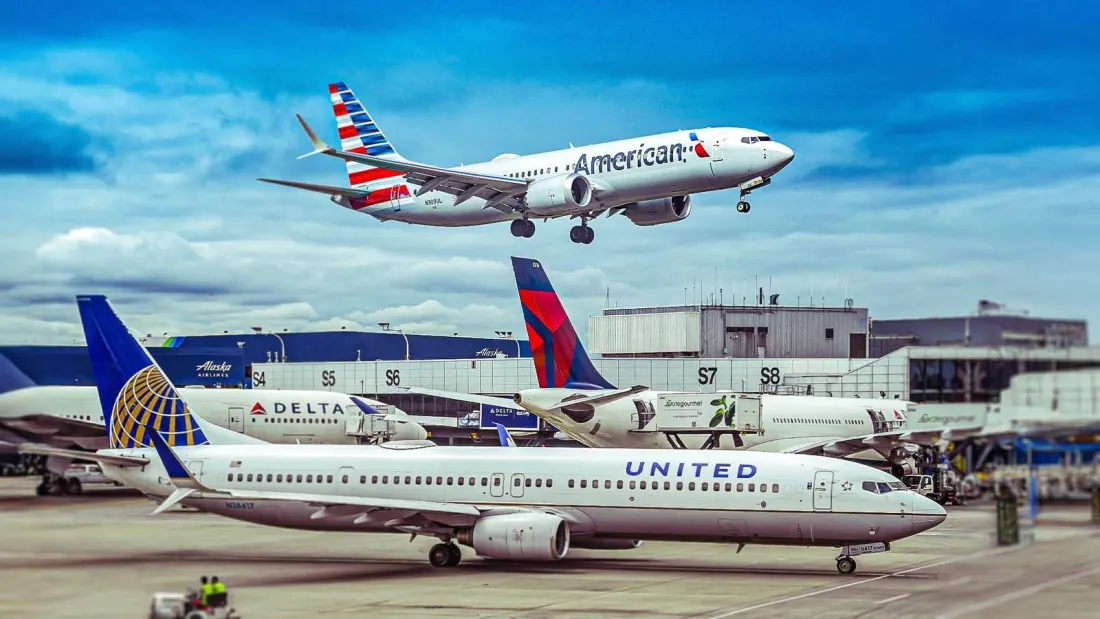
Chicago O'Hare has become the most contested patch of concrete in US aviation. United Airlines and American Airlines are locked in a fight over gates, flight slots and local flyer loyalty that has spilled from city hall into courtrooms — and it directly shapes schedules, fares and connection options for anyone flying through the Midwest's biggest hub.
The roots are mathematical. O'Hare's roughly 200 gates are handed out under the City of Chicago's use-and-lease agreement, where gate assignments follow each airline's share of departures. Fly more, keep or gain gates; pull back and lose concourse space. In late 2025 a gate reallocation went United's way, and American sued the city in May 2025 — losing first in federal court, then in Cook County Chancery. Both carriers then went shopping in Spirit Airlines' bankruptcy: United bought gates G12 and G14 on Concourse G for $30.2 million, while American grabbed G8 and G10 for $30 million, conveniently next to one of its Admirals Club lounges. United now leans on a footprint of roughly 95 to 99 gates; American holds 66 after the reshuffle.
Both are also inflating schedules, because departure volume feeds the next gate review. United announced a broad 2026 expansion with new routes and added frequencies, and CEO Scott Kirby has pledged not to give up a single gate. American's Robert Isom has framed O'Hare as equally non-negotiable, especially after the airline lost ground in New York and Los Angeles.
There's a physical ceiling, though. With taxiway rehabilitation and terminal work under way, the FAA stepped in on April 20, 2026, capping daily operations at 2,708 flights between 6am and midnight — well below the 3,000-plus schedules airlines had published. The order runs through October 30, 2027, forcing carriers to cut frequencies, delay seasonal routes or fly larger planes. Relief is slow: the ORDNext expansion has ballooned from $8.5 billion to $12 billion, and the new Global Terminal isn't due until 2034.
Why does this matter beyond aviation geeks? Loyalty money. Co-branded credit cards and frequent-flyer programmes generate billions in high-margin revenue, and Chicago is full of high-spending cardholders. Whoever wins local hearts wins everyday card spend, not just seat sales. That's why neither airline will blink first — and why travellers can expect aggressive fares and route competition at O'Hare for years, alongside some congestion pain while construction grinds on. If you're connecting through Chicago, expect fuller planes, tighter peak-hour schedules and a concourse map still shuffling well into the 2030s.