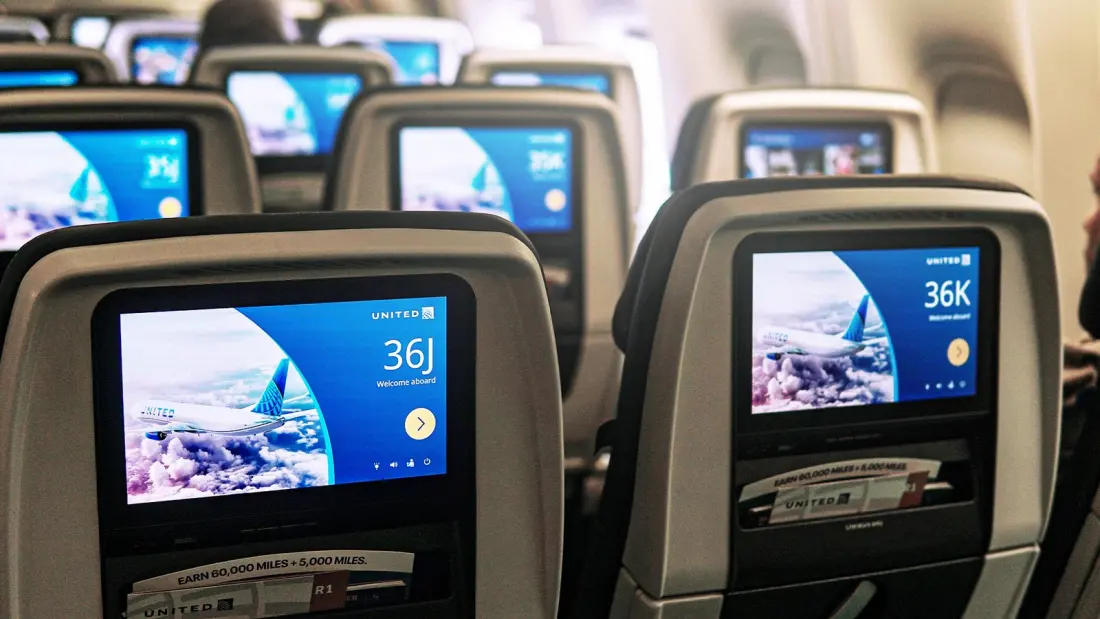
Deep at the back of United Airlines' Boeing 767s sit four seats that shouldn't exist in economy: 43 inches of pitch, leg rests that extend, footrests, roughly seven inches of recline, and even draw curtains for privacy. That's a full foot more legroom than the airline's standard 31 inches — and nine inches more than Economy Plus. In fact, they beat United's own Premium Plus cabin by five inches of pitch. In economy. At the back.
The catch: these seats were designed for flight attendants, not passengers. On long international sectors such as Newark to São Paulo or Washington Dulles to Barcelona, crew are required to take rest breaks on flights running longer than about eight hours. Rather than installing a crew bunk compartment, United converted these seats — rows 52 and 53, positions A and B on the left side of the cabin on its 16 Boeing 767-400ERs — into a curtained-off rest area. The unusual footprint makes sense in that light: the four seats take up roughly the same space as six or seven standard economy seats, which is why United doesn't run them as a regular product.
When the 767-400ER flies shorter routes — often transcontinental domestic hops — no mandated crew rest is needed, and United can release the seats to passengers. They typically appear on the seat map as Economy Plus, but don't expect to grab them months ahead: United tends to block them well in advance and only releases them around 24 to 48 hours before departure if crew rest isn't required.
There are ways to improve your odds. Anyone with United Silver status or above can pick Economy Plus seats at no cost — Silvers at check-in, Gold, Platinum, 1K and Global Services members at booking. So if you're elite and see those seats free up close to departure, you can snap them up without paying an upgrade fee. Everyone else booked in standard economy will need to pay for Economy Plus to be eligible.
Spotting the right aircraft is the first step. United's 767-400ERs run a three-cabin layout with 231 seats — 34 Polaris business, 24 Premium Plus and 173 in Economy/Economy Plus — and economy is in a 2-3-2 configuration, which distinguishes the 767 from most other United widebodies. The magic four are 52A, 52B, 53A and 53B. United's 767-300ERs also carry the same crew-rest setup; there, look for rows 43 and 44 instead. Checking a seat map database before booking will confirm what you're dealing with.
It's also worth knowing that this blocked-seats approach is normal across United's smaller long-haul fleet. On 757s and 737s, the airline curtains off rows of economy and reserves a business or first-class seat for relief pilots. American Airlines plans something similar on its incoming A321XLRs, converting two rows into a curtained sleeper couch for cabin crew.
Why care? Because knowing the aircraft and the seat numbers turns a lucky accident into a strategy. Time your booking, watch the seat map in the final two days before departure, and you might score the most comfortable seat in United's entire economy cabin for the price of an Economy Plus upgrade — seats the airline built for its crew, but will happily sell to you when nobody's napping in them.