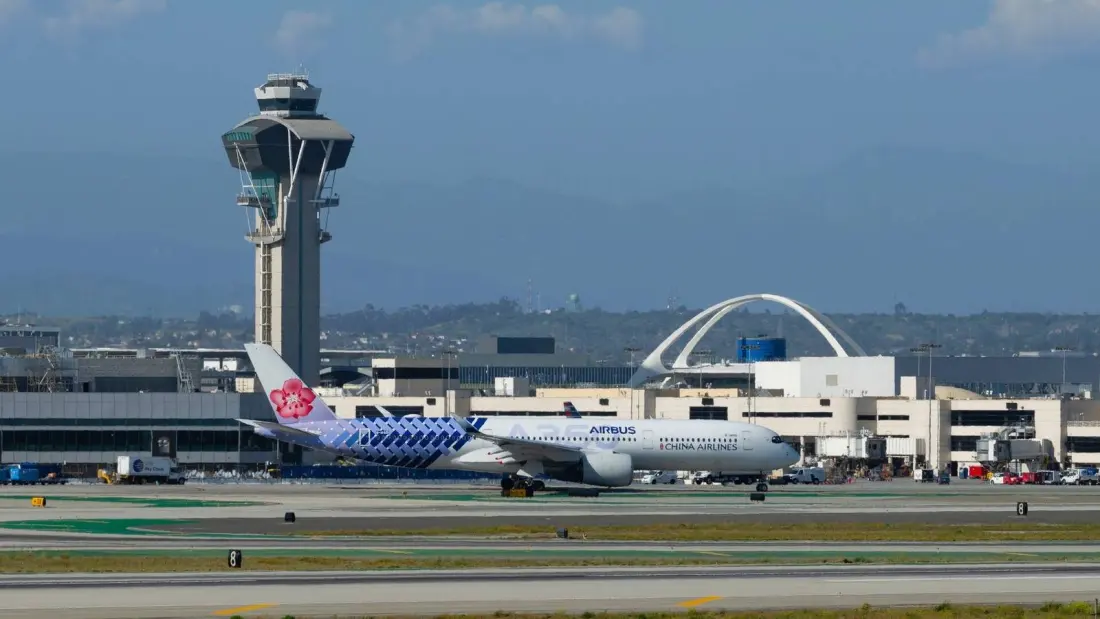
A severed fibre-optic cable in New Jersey brought much of the US Northeast's airspace to a standstill on Monday, September 21, and within 24 hours Washington had a response: Transportation Secretary Sean Duffy announced a request for an additional $30 billion in aviation funding.
The outage began around 9:30 AM when the primary telecoms system failed at Philadelphia TRACON, the facility handling approach traffic for Philadelphia and, through its Area C, Newark. Controllers fell back to a backup line — only to find it had been accidentally cut during construction work. Newark effectively lost commercial arrivals for most of the day, flights were diverted to 34 different airports, and ground stops rippled across Newark, JFK, LaGuardia and Philadelphia. By the time communications were restored, roughly 9,500 US flights were delayed or cancelled, more than 100 aircraft had diverted, and Newark alone saw over 600 cancellations. Normal service resumed the following day.
Duffy's proposal splits the new money three ways: about $10 billion to replace ageing control towers, $10 billion for telecoms and ATC technology, and $10 billion for airport infrastructure. Added to the $12.5 billion Congress already approved in 2025 for the FAA's Brand New Air Traffic Control System, that would bring total federal investment to roughly $42.5 billion — though the FAA itself estimates a second phase of systems modernisation will need another $10.2 billion on top.
The scale is driven by how antiquated the equipment is. The FAA's shopping list includes 5,170 high-speed network connections, 27,625 radios, 462 digital voice switches and 612 new radars, plus surface surveillance at 200 airports and electronic displays at 435 towers. Equipment-related delays in 2025 are running around triple the 2010–2024 average. Some progress is real: over 64% of legacy copper telecom lines have been replaced, and the FAA says obsolete copper will be gone by September 2027. On the very day of the outage, the agency also quietly launched SMART, an AI platform blending about 200 data streams to predict congestion and weather disruptions before they cascade.
Why should travellers care? Because the Northeast corridor — New York, Newark, Philadelphia, Boston, Washington — is one of the busiest and most delay-prone airspaces on earth, and a single cable failure there can wreck itineraries across the country. Until the rebuild is done (Phase 1 targets December 2028; Phase 2 has no dates yet), the practical advice stands: build generous connections through Northeast hubs, favour nonstops where possible, and expect disruption days like this one to recur. Whether Congress funds the full ask — and whether the final bill, which the GAO says the FAA cannot yet estimate, stays anywhere near these figures — will shape US flying for the next two decades.