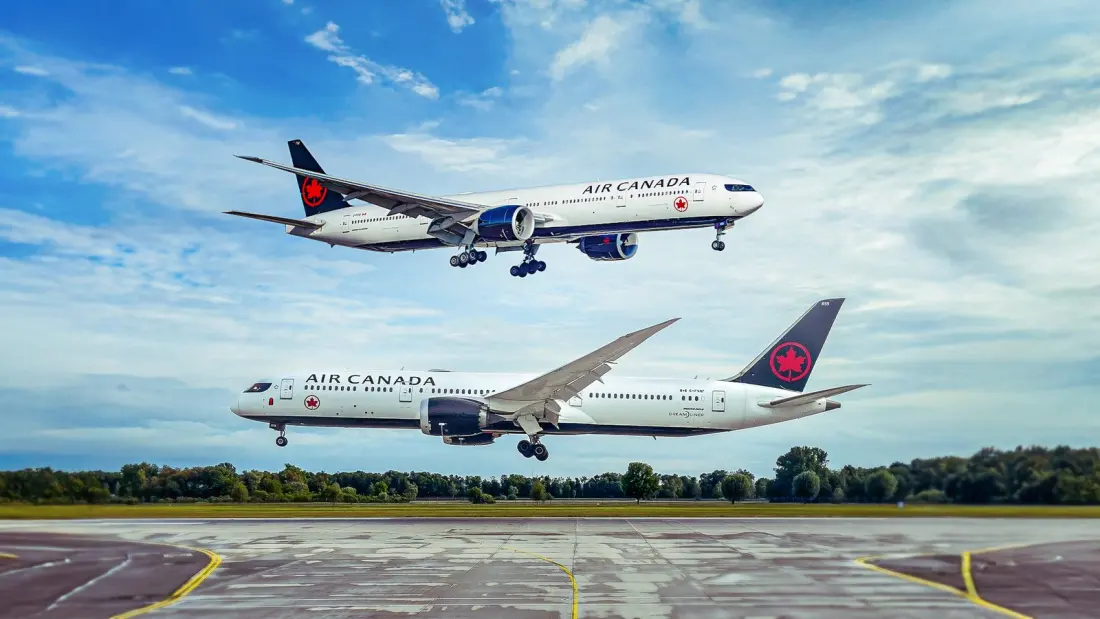
Book a long-haul flight with Air Canada and the aircraft you end up on shapes the whole experience — seat layout, cabin refresh, even how likely a swap is. The carrier's long-haul operation runs on 85 passenger widebodies out of its Toronto, Montreal and Vancouver hubs, and each type has a distinct job.
The heavy lifting falls to 25 Boeing 777s: 19 high-capacity 777-300ERs and 6 ultra-long-range 777-200LRs. Seven of the -300ERs are squeezed to 440 seats (down from 450 after a weight-saving row removal) and tend to appear on dense leisure and VFR routes to Europe, Asia and the Caribbean. The -200LRs, with 300 seats across three cabins, fly point-to-point ultra-long sectors like Australia and South America.
The Dreamliner is the network's workhorse for growth. Air Canada has 40 of them: 32 787-9s with 298 seats anchoring transatlantic and transpacific frequencies, and 8 smaller 787-8s with 255 seats. The -8's lower capacity is what lets the airline trial riskier routes into secondary European cities without betting the farm — so if you're flying to a less obvious destination, a 787-8 is probably under you.
Then there's the 20-strong Airbus A330-300 fleet: older, owned outright, and cheap to run on paper. They fly domestic transcontinental Toronto–Vancouver legs plus seasonal transatlantic services to places like Dublin and Manchester, with refreshed Signature Class interiors. Meanwhile the fuel-efficient 787-9s are preserved for wind-critical transpacific routes to Tokyo Haneda and Sydney.
Change is coming. Fourteen larger 787-10s arrive from late 2026, sharing a common type rating with the existing Dreamliners so crews and aircraft can be swapped freely. And in a genuine strategic shift, Air Canada ordered eight Airbus A350-1000s in February 2026 — its first direct Airbus widebody order since the late 1990s — with deliveries from late 2030 to replace the 777-300ER flagship fleet. Boeing's 777X lost out on fuel burn, weight and delivery timing.
For travellers, the practical read: expect the most modern cabins on 787 routes, decent refurbished product on A330 transatlantic seasonals, and the highest-density seating on 777-300ER leisure routes. Over the next decade the fleet consolidates around Dreamliners and A350s, which should mean a more consistent long-haul product across the network.