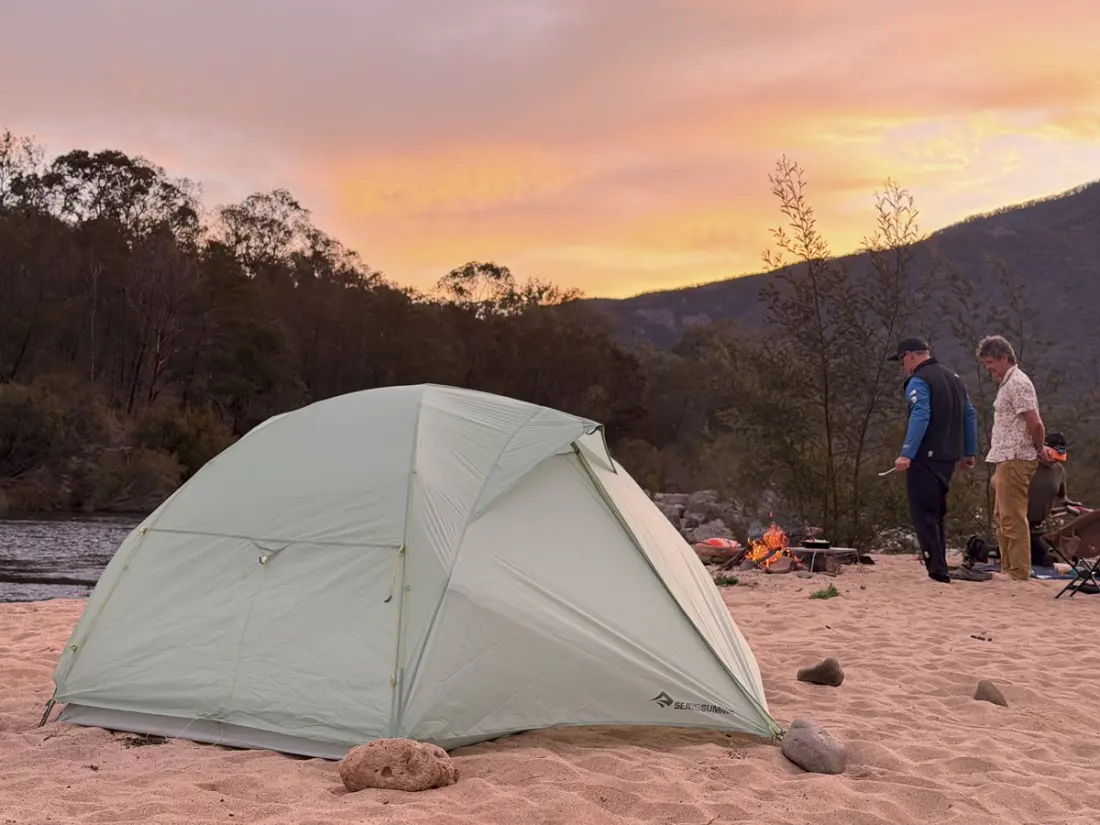
Most tents perform fine in calm weather. The real test is the night the wind picks up and rain turns your campsite into a shallow lake. That's the brief Australian set out to answer with its new Sentinel XP range, and after a month with the two-person XP2 — including a multi-day packrafting trip down Victoria's Snowy River — a reviewer for Australian Geographic thinks the brand has nailed it.
The XP2 sits deliberately between ultralight backpacking tents and heavy expedition shelters. At 1870g trail weight (2120g packed) it's no gram-counter's dream, but the trade-off is serious weather resistance. Sea to Summit rates it for winds up to 80km/h, helped by zippered AirLift vents at each end that equalise air pressure and stop the frame buckling in gusts. The floor is the standout: 40-denier nylon with a 25,000mm hydrostatic head rating — roughly five to ten times tougher than typical lightweight tent floors. The Low Stretch flysheet uses polyester reinforcement so it won't sag into a wet flapping mess.
Space is respectable for the weight: a 2.86m² rectangular floor, 109cm of headroom and two vestibules adding 1.82m² of gear storage. Near-vertical walls mean two full-size sleeping mats fit without a border dispute, and a 188cm-tall tester had room to sit up.
The smaller details are where it wins people over. Colour-coded poles and a symmetrical design make pitching nearly foolproof, machined aluminium HoldFast clips work easily with gloves on, and the genuine paracord guy lines are half the weight of the cheap nylon found on many rivals. The fly pitches inner-first in fine weather or fly-first in a downpour, and can be used on its own with a ground sheet. Roll the fly back for stargazing, or prop one side on trekking poles for what the brand calls Hangout Mode — a covered porch for brewing coffee while the rain passes. Even the pole bag doubles as a headtorch diffuser.
Niggles are minor. The pale fly and white inner show dirt, and one humid, still night beside the Snowy River brought condensation inside the fly — though every tent in the group suffered equally, and drier trips were trouble-free.
At $899 it's not cheap, and it's not built for snow or for anyone obsessing over grams. But for backpacking, packrafting and multi-day hikes where the forecast is a gamble, the verdict is simple: a well-thought-out, versatile three-season shelter that keeps you comfortable when the weather isn't. The range also comes in one- and three-person versions.
Australian Geographic