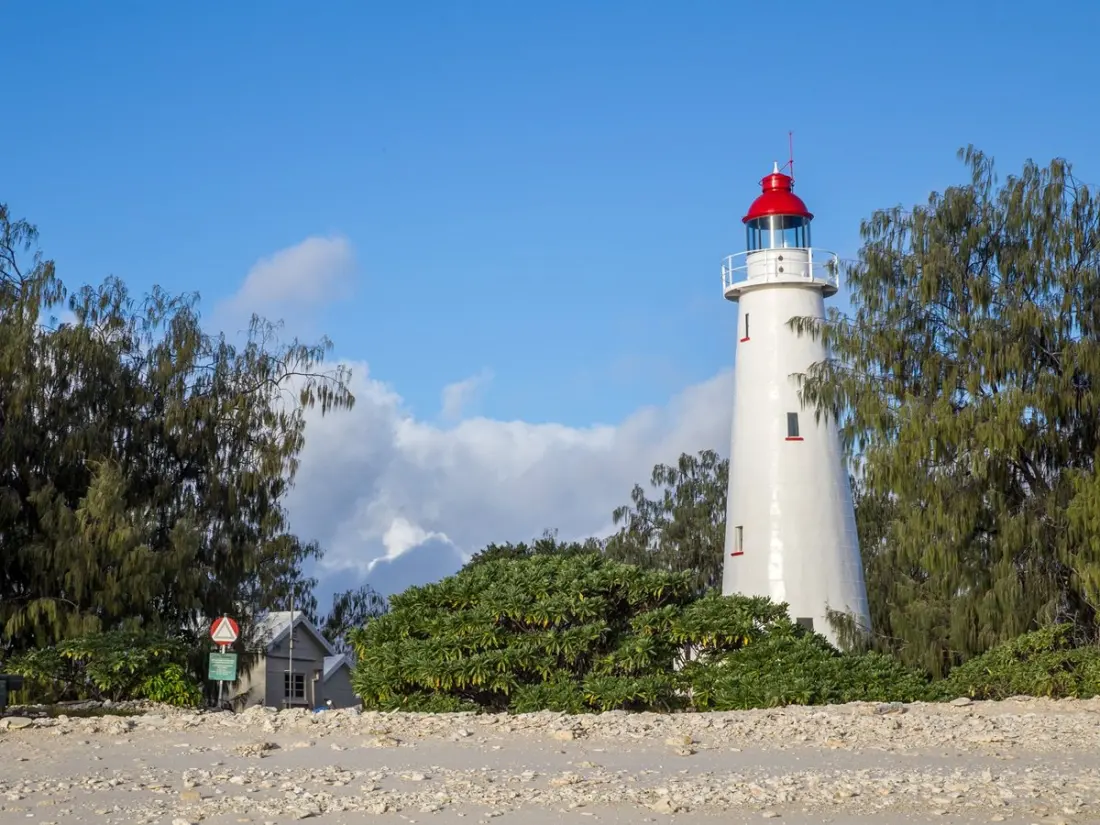
Stand on Lady Elliot Island after dark, turn your back on its real lighthouse and stare out to sea, and you may swear you can see a beam sweeping from the horizon. There is nothing out there. Yet the illusion is so reliable it gets a mention in the island's own visitor guide — and even checking behind you won't shake it.
Researchers from the University of Melbourne, psychologists Simon Cropper and Charles Kemp, travelled to the island at the southern tip of the Great Barrier Reef to investigate. They then rebuilt the scene in virtual reality, and the lab results matched what people experience in the wild. The trick, it turns out, is that at night there are almost no visual cues to judge distance. With sparse evidence, your brain leans heavily on expectations — and it expects the far end of a lighthouse beam to be far closer than it really is.
Here's the mechanism in plain terms. The real lighthouse sits roughly 300 metres behind you. Its beam passes over your head and stretches far out to sea. The distant end of that beam is both very far away and moving extremely fast. But your brain, lacking depth information, reads it as something nearer and moving more slowly — and the most natural interpretation of a slow-moving light 'out there' is that the source sits on the horizon in front of you. Hence a lighthouse that doesn't exist.
The study also produced a surprising number. Earlier reports placed the illusion at distances of one to four kilometres from a lighthouse. The researchers' theory predicted it should kick in at just 70 metres — and that turned out to be right, both in VR and in person on Lady Elliot. Stand 70 metres or more from the light, between it and the water, and the phantom appears.
The wider point is that the brain works as a 'prediction machine', blending expectation with incoming data. Usually that serves us well — it's the same machinery that lets us read ambiguous scenes instantly, though it can trip us up in other ways, like the classic crater illusion where astronomers can't tell a hole from a dome because they assume light comes from above.
Why should travellers care? Lady Elliot Island is a genuine destination — a small coral cay famed for manta rays, snorkelling and seabird colonies, with the historic lighthouse as one of its few structures. If you overnight there, the phantom lighthouse is a free, weird after-dinner experiment you can run yourself: walk 70-plus metres seaward of the light, turn around, and watch your own brain manufacture a lighthouse on the horizon. It's a rare chance to experience a documented perceptual illusion in the wild rather than a lab. Just don't expect knowing the explanation to make it go away — it doesn't.
The phenomenon isn't unique to this island either; the earliest published report dates to 1937 and described the same effect off the coast of Brittany in France. So if you're near any remote lighthouse after dark, it may be worth a look. Original article via Australian Geographic.