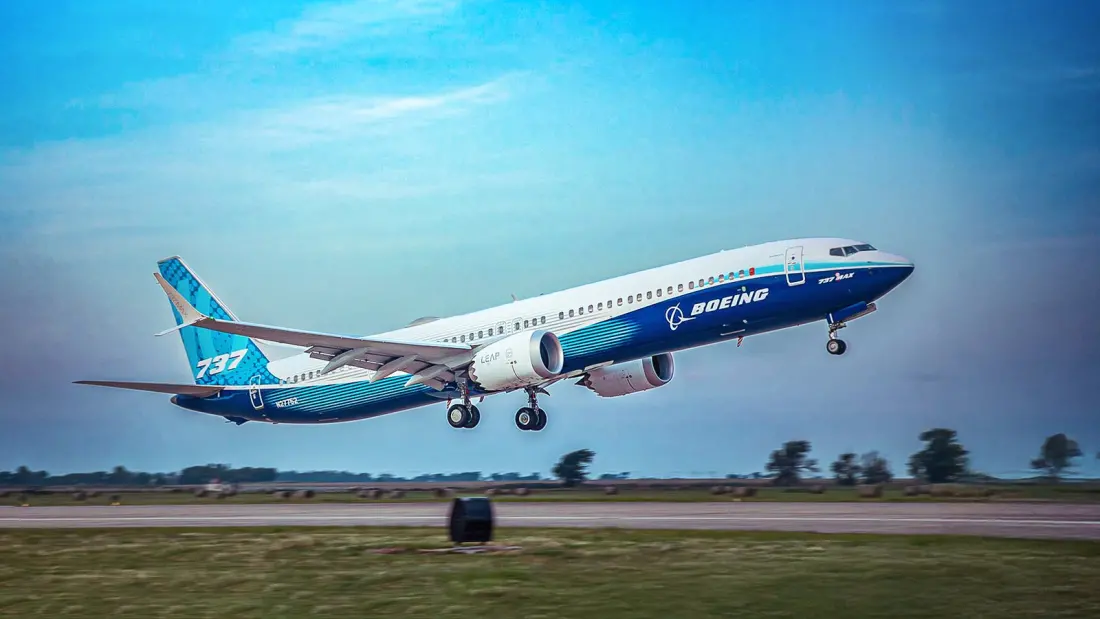
The two biggest narrowbody jets in the sky were built for completely different jobs, and the gap between them is about to shape which planes you find on transatlantic routes. Airbus's A321XLR, already in service with more than 500 orders, can fly up to 4,700 nautical miles (8,704 km) — roughly 11 hours. Boeing's 737 MAX 10, still awaiting certification, tops out at 3,100 nautical miles (5,741 km). That 1,600-mile difference is no accident.
The MAX 10 is the longest stretch of an airframe design that dates back to the original 737. It keeps the family's wing and fuel capacity — 6,820 US gallons — while squeezing in up to 230 seats. Adding seats adds weight, and more fuel would demand a new wing, new landing gear and, essentially, a new aircraft. Even the smaller MAX 8 flies farther (3,500 nm) simply because it carries less weight. Boeing's clever semi-levered landing gear, which grows 9.5 inches taller on the ground to prevent tail strikes, solved the stretch problem but also confirmed the airframe has reached its practical limits.
Airbus started from a larger baseline — the A321neo — and added a permanent rear fuel tank holding 3,408 US gallons, raised maximum takeoff weight to 101.5 tonnes, and reinforced the structure and gear as a coordinated package. The result is an aircraft explicitly marketed as a route opener for long-haul point-to-point flying. Air Canada, for one, plans nonstop A321XLR services from Montreal and Toronto to Berlin, Toulouse and Edinburgh.
That doesn't make the MAX 10 a failure — it's a different bet. Boeing claims the best per-seat economics of any single-aisle jet and says it covers 99% of single-aisle routes. Alaska Airlines illustrated the logic in January 2026 by ordering 105 MAX 10s (plus 35 options) for dense domestic routes, while pairing the deal with five 787s for long-haul growth. Use the narrowbody where filling seats matters, the widebody where distance does.
For now, the MAX 10's entry into service is on hold. Boeing finished flight testing in July 2026 — 976 flights, over 2,060 hours — but the FAA has delayed certification over a newly identified software issue affecting automated flight guidance during a go-around. The variant represents roughly 31% of Boeing's undelivered 737 backlog, and Alaska expects its first delivery in spring 2027.
For travellers, the takeaway is simple: the future of affordable transatlantic flying in smaller planes belongs to the A321XLR and its rivals, not the biggest 737. Expect more point-to-point routes from secondary cities on fuel-efficient narrowbodies, while the MAX 10 concentrates on high-frequency, high-density routes closer to home. Boeing's next move, most analysts agree, will need to be a clean-sheet design rather than another stretch.